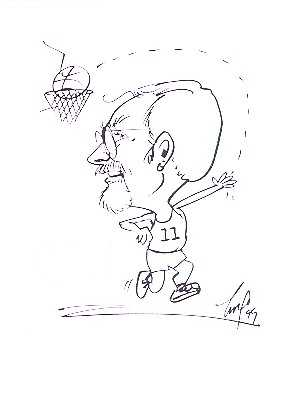
Over at another blog-site, Dr Rieux asks:
Is Unitarian Universalism a Religion? [warning; long!] Tried to post a comment there, but found the registration process so tedious that I decided to post here and link instead.
Not to make light of everything that has been written here, but you are really asking all the wrong questions. Notwithstanding Sinkford's loose-lipped efforts to keep reverence afloat, and the rather depressing fact that "Unitarian-Universalism" is now a registered trademark, it seems to me that what really matters is figuring out whether "Our Liberal Movement in Theology" is best understood as:
1) An historically liberal Protestant Christian denomination and successor organization to two other historically liberal Protestant Christian denominations;
2) A post-Christian Protestant heresy open to the wisdom and inspiration of all the world's great religious traditions;
3) Its own "New Religion," with rather grandiose aspirations of eventually supplanting all of the world's more traditional religions;
4) Secularism in "religious clothing"...or as someone once put it (maybe me), "the Progressive Wing of the Democratic Party at...if not prayer, then some superficial imitation of same."
I'm not going to weigh in with my opinion (if it isn't obvious already which way my sentiments run), mostly because I think the REAL answer is "all of the above." But I'm not so sure that's the BEST answer. And that's what really concerns me about the future of our so-called "living" faith/religious tradition....
Friday, November 30, 2007

Friday, November 23, 2007
Coming this XMAS to an XBOX near you
Compliments of the US Army, and Redstorm Entertainment. www.truesoldiersgame.com
Monday, November 12, 2007
Congregations Count (Part Two)
Inspired by Linda Laskowski's discovery and comment on my earlier post summarizing her excellent GA workshop last summer, here are a few of the tools we've developed here at First Parish to assist us in our Membership Outreach process.
VISITORS LETTER: [this goes out from me personally to every first-time visitor to First Parish within 48 hours of their visit, and always concludes with a handwritten postscript. I'm not entirely satisfied with the letter itself (even though I wrote it); the tone has a little too much "sizzle," and not quite enough specific information for my taste. But since we are still evolving our other processes around Newcomers Conversations, the New UU Class and the like, it wasn't possible to be any more specific]
Name
Address
City State Zip
Dear Name:
Welcome to the First Parish in Portland! I’m so pleased that you decided to worship with us Sunday, and hope that you will find here the kind of active, liberal, free-thinking faith community you’ve been searching for. As minister of this congregation, I’m especially interested in seeing to it that your experience here is a warm and welcoming one, as you decide in your own way and at your own speed whether or not First Parish is for you. Many of us looked long and hard before we found a place we could comfortably call our spiritual home. Perhaps at First Parish, you will discover yours as well.
Some people think of a church merely as a building: a physical structure of granite and mortar, glass and plaster, standing tall in the center of the city as a visible landmark in the landscape of the larger community.
Others think of church principally as a religious institution: an organization with principles and purposes, policies and by-laws, and charged with the mission of doing God’s work in the world.
Theologians sometimes speak of “the Church” as a mystical body of believers: a spiritual community of faith, memory and hope, which transcends the boundaries of time or space.
But when I think of church, I think of people. Real people, like you and me, who inhabit the building, who embody the spirit, who are profoundly committed to doing God’s good works with their own two hands.
The First Parish in Portland is a spiritual community of real people walking together in covenantal relationship one with another, and devoted to important values and principles larger than ourselves. It takes each and every one of us working side by side to make our faith community everything it should be. If your experience of organized religion in the past hasn’t quite lived up to your expectations, I invite you to join with us in creating something worthy of your hopes and dreams and aspirations. It may well be that the only thing missing from this CH_RCH is U.
Faithfully Yours,
Tim W. Jensen, Parish Minister
***
[PATHWAY TO MEMBERSHIP - this is the "roadmap" which our Membership committee is using to help track, guide, and support newcomers through their journey to formal membership in our congregation]
The Path to Membership at First Parish
OVERVIEW: Often when churches begin discussing ways to “grow” their membership, they allow themselves to be distracted by the numbers, and forget that numbers are merely a marker for measuring how successfully we are performing our core mission, which is transforming people’s lives for the better.
Perhaps a better way to think of growth is as an expression of our “ministry of hospitality.” Our church is like a feast, a banquet, a party to which everyone is invited, and it’s our responsibility as hosts to make certain that everybody feels safe and welcome, and that they are getting fed, meeting the other guests, can find what they need, and are basically having a good time.
Research shows that first-time visitors to a church typically follow a predictable “path” to eventual membership, and that growing churches tend to be aware of that path, and take steps to help newcomers move along it smoothly as they decide for themselves whether or not a participation in the life and community of a particular congregation is going to be part of their own spiritual journey. The world may well beat a path to our door in search of a better mousetrap, but it helps if there are at least signposts pointing the way, so that they don’t accidentally become lost in the woods.
Step One: Attraction (Invitation & Recruitment) - “Come on in, the water’s fine!”
• This is typically the most difficult element to control, and the most expensive to influence significantly. But there are a variety of ways in which we can work to raise our profile and enhance our reputation in the wider community, and this goal should be pursued in an intentional manner.
• Our central location is also a valuable asset that contributes significantly to our public visibility. Small things like the Wayside Pulpit and our Reader Board can do a lot to attract people’s attention and invite them through the front door.
• Our Website is likewise a very important vehicle for encouraging “seekers” to visit our church in person. A “FAQ for Visitors” is being developed, and will be added to our homepage as soon as it is ready.
• Far and away the most effective method for attracting newcomers to our church is “word of mouth” combined with a personal invitation from someone they know. Thus much of our work in “recruitment” is actually creating the kind of environment where people feel comfortable inviting their friends, and creating the kind of institutional culture where that sort of invitation becomes normal.
Step Two: First Impressions - “Getting Your Feet Wet”
• This is VERY IMPORTANT! Although First Parish feels like a second home to many of us, visiting an unfamiliar church for the first time can be a very intimidating experience. Likewise, most first-time visitors to a church make up their minds within five minutes whether or not they will return a second time.
• Visitors and Members alike are warmly welcomed by a Greeter from the Membership Committee as they arrive in the Vestibule. Current Members are reminded to wear their name tags; visitors are invited to make a nametag, and also to sign our guest register or fill out a visitors card at the Greeters Table. The Ushers continue to distribute Orders of Service and the Sunday Bulletin (which now contains information specifically of interest to newcomers) as they have in the past.
• Visitors are explicitly welcomed to our church by the Worship Leader, and invited to coffee hour following the service. In the coffee hour, a “Newcomers/Welcome Table” containing information about First Parish and Unitarian Universalism is staffed by representatives of the Membership Committee. “Gold Cup Greeters” circulate through the coffee hour, introducing themselves to people they don’t recognize (something as simple as “Hi! I don’t think we’ve met before”), and personally welcoming them to the church.
• Follow -up postcards from the Greeters-on-duty are addressed and sent that same day to each first-time visitor. The names of these visitors are also reported to the office for inclusion in our “Prospective New Members” database.
Step Three: Returning to Explore - “Wading Right In”
• In addition to the postcard, a Welcoming Letter from the Minister is sent to each first time visitor, once again welcoming them to the church and inviting them to participate as they choose in a variety of activities designed specifically for newcomers (see below).
• If the visitor has indicated specific areas of interest on their visitors card, these are followed up separately by the appropriate volunteer in charge of that activity.
• “Permanent” nametags are made for each visitor, in order that we might more easily track those who return for a second time, and also so that each second time visitor finds something “belonging” to them waiting for them if and when they return.
• Approximately one Sunday per month there is a “Welcoming Conversation with the Minister,” where Newcomers have an opportunity to ask their questions about UU & FP in a semi-structured environment.
• As needed, a three-session “New UU” class is offered for individuals who are specifically interested in becoming members of the church.
Step Four: Commitment - “Taking the Plunge” (formally becoming an “Official” Member of First Parish).
• Following completion of the New UU class, individuals are personally invited to become members of First Parish.
• Those who wish to become members sign the membership book, and are formally welcomed into Membership at a brief ceremony during the Sunday Morning worship service
• It’s important to recognize that the decision to become a member of a church is a very personal thing, and that some individuals will choose NOT to affiliate officially with the church, but will still participate actively in many of our programs and ministries. This is OK.
• SHORT CUT FOR “EXPERIENCED” UUs. Some individuals will arrive at First Parish already familiar with Unitarian Universalism, and perhaps having already been a member of another UU congregation. These individuals will be told that they are welcome to participate in the classes if they like, but may also simply join the church by privately signing the book after a conversation with the minister.
Step Five: Discipleship - “Going Deeper” (Making Your Membership Work for You)
• As part of their New Member orientation, each new member will be encouraged to find both some sort of program, activity, or “fellowship circle” which enhances their own spiritual life, and also to find some sort of volunteer opportunity which supports the larger mission and ministry of the church (see below). “One hand for the boat, and one hand for yourself.”
• It is important that a “catalog” of potential activities be visible and accessible to new members. Potential Fellowship Circles include participation in a covenant group or other Small Group Ministry, membership in the choir, enrollment in a life-long learning class, or participation in any one of the dozens of activities which take place here every year.
• The underlying goal here is not only to deepen and enrich the quality of each new member’s faith experience. We are also attempting to integrate them into our larger community in a meaningful and fulfilling way. A good benchmark for this process is the formula “Six friends in Six months.”
Step Six: Vocation - “Being Sent” by finding Meaningful Work that supports the larger Mission and Ministry of the Church.
• Often there is a great deal of overlap between “Going Deeper” and “Being Sent.” But it would be a mistake to assume that every committee is a “fellowship circle,” or that volunteer work alone is enough to deepen someone’s faith experience in a meaningful way
• At the same time, it is important that new members (and long time members as well) recognize that their contributions large or small are important and appreciated, and that they are (to continue the nautical metaphor) valued members of the crew and not just passengers along for the ride.
• A membership/volunteer coordinator should work with the nominating committee to try to find a meaningful job for every person in the church. It can be large or small, it should be self-selected if possible, it needs to contribute in a recognizable way to the work of the church as a whole, and it needs to be recognized and publicly acknowledged as well. Simply committing to attend services regularly (and, of course, to greet the people sitting around you and sing the hymns enthusiastically) qualifies as a “meaningful job,” provided it is done in a meaningful and committed way.
***
SO, WHAT ARE YOU WAITING FOR? [this is a little brochure which we use as literature targeted specifically at return visitors, which basically outlines the Path to Membership from the perspective of someone who is on it.]
If you’re still relatively new to First Parish, and trying to figure out how best to navigate the currents and eddys of our shared congregational life, here are a few handy tips to help you get right into the swim of things!
Get Your Feet Wet. Keep attending Sunday Services, and be sure to make time afterwards to join us for conversation and refreshments in the Parish House parlour. Fill out a Visitors Card, so that you can begin receiving and reading our monthly newsletter, “Stone Soup.” Stop by the Welcome Table in the Parish House and talk with the friendly people there. Take home some of our literature, or Google “Unitarian Universalism” on the internet. Attend a “Conversation with the Minister” (generally held right after church on the first Sunday of each month), and ask the most challenging questions you can think of. We may not have all the answers, but at least we can try to point you in the right direction!
Wade Right In. Sign up for our “Explorer Series” of Orientation Classes (starting in January), or enroll in one of our many other Lifelong Learning offerings. Participate in a Faith in Action event. Try out for the Choir. Join a Covenant Group, or one of our other Small Group Ministries. Come to a potluck, or a Circle Supper. Sign up to be a greeter, an usher, a helper in the Sunday School. Light a candle during “Joys & Sorrows.” Or just keep sitting in your favorite seat there on the aisle near the back of the Meeting House week after week until folks start to think that the pew belongs to you. Do as much or as little as you like; it’s all up to you.
Take the Plunge! Formal membership in a faith community means different things to different people. But if you should decide that you want to “sign the book” and become an official member of the Congregational Society at First Parish, we would hope that you would at least feel comfortable with all or most of the following:
• Be familiar with the basic programs and activities at First Parish, and feel at home thinking and speaking of this church as “your” church.
• Within the natural constraints of your particular lifestyle and whatever other personal obligations you may have, attend Sunday Worship as regularly as you can.
• Appropriate to your personal situation and financial means, generously support the work and ministry of this congregation.
• Find and join some sort of “Fellowship Circle,” so that you might enrich your own spiritual journey by sharing it with others, and forming durable and significant relationships of mutual accountability and support. A Fellowship Circle might be a Covenant Group, or one of our other Small Group Ministries; it could be an on-going class, a regular social group, the Choir, or even a working committee. The main thing is that your Circle consist of people you know and trust and see on a regular basis, and with whom you feel comfortable sharing your thoughts and feelings about “matters of ultimate concern.”
• Identify some sort of job, task, role or responsibility that feeds your soul and which you can think of as your “ministry.” Remember the old sailing rule, “One hand for the boat; One hand for yourself” – we want you to feel like you are one of the crew, and not just a passenger along for the ride. The ministry you choose doesn’t have to be forever. In fact, we encourage you to change and grow your particular ministry as you yourself change and grow.
• Become conversant with the basic history and principles of the Unitarian and Universalist faith traditions, and reasonably comfortable talking with others about what your experience at First Parish means to you.
• Meet six new and interesting people here at First Parish who you didn’t know before you came here, and become friends. And if you think your current friends might like what we do here as much as you do, invite them to visit us, so that we might get to know them too. This is how communities grow, one relationship at a time.
• Have Fun! It’s the sine qua non of life at First Parish. (If you’re not really sure what that means yet, don’t worry. Learning obscure stuff like this is half the fun anyway!)
***
[These are just some random thoughts I sent to my leadership team regarding our advertising/public relations strategy, and how I felt we might most effectively target those resources]
THINKING ABOUT OUTREACH

A lot of people have been expressing to me a desire to see First Parish do something more effective in the way of advertising, in order to attract more people to our congregation. But in my experience, effectively advertising a church can be a tricky business, where if you don’t know what you’re doing it is easy to spend an awful lot of money without much positive result (and in some cases, even a negative one). So here are some of my reflections on the subject, as we start to think about moving forward in this area.
• The notion that we can simply purchase more and better advertising and that more (and better) people will begin attending church on Sunday mornings as a result is deceptively naïve. We need to be very specific, targeted, focused and intentional about what we hope to accomplish in “marketing” First Parish, and how best to go about achieving those objectives in an effective and economical way.
• One specific starting place might be to examine more closely what we are already doing in the way of “static” advertising (our exterior and interior signage, our pamphlets and literature, our Yellow Pages ads, our Saturday newspaper ad, and especially our newsletter and website), in order to determine whether or not we are portraying a consistent identity (or “brand”), and how we might better use these tools to reinforce the identity we would like to portray.
• Likewise, rather than presuming that the purpose of a Public Relations campaign is simply to attract more newcomers through the front doors (who may or may not return and eventually join First Parish), we might frame our objectives in both a broader and a more nuanced manner, by asking:
--what might we specifically do to improve the image, reinforce the identity, and raise the visibility of First Parish in the larger community? [i.e. to increase our “brand recognition”]
--what can we do to promote specific events of interest to the larger community other than Sunday Services that are taking place here at First Parish? [i.e. to create and promote alternative entry points]
--what can we do to inspire our current members to become more deeply involved at First Parish, and to encourage them to invite their friends?
Finally, I just want to make it clear that advertising alone is not going to grow the church all by itself. It’s just not enough merely to get people through the front door; we also need to welcome them warmly, anticipate their needs and desires, and effectively satisfy those expectations so that they will return and bring their friends. If we FAIL to do these things, we are probably better off NOT advertising, since newcomers who are disappointed by their experience here will probably tell their friends as well….
VISITORS LETTER: [this goes out from me personally to every first-time visitor to First Parish within 48 hours of their visit, and always concludes with a handwritten postscript. I'm not entirely satisfied with the letter itself (even though I wrote it); the tone has a little too much "sizzle," and not quite enough specific information for my taste. But since we are still evolving our other processes around Newcomers Conversations, the New UU Class and the like, it wasn't possible to be any more specific]
Name
Address
City State Zip
Dear Name:
Welcome to the First Parish in Portland! I’m so pleased that you decided to worship with us Sunday, and hope that you will find here the kind of active, liberal, free-thinking faith community you’ve been searching for. As minister of this congregation, I’m especially interested in seeing to it that your experience here is a warm and welcoming one, as you decide in your own way and at your own speed whether or not First Parish is for you. Many of us looked long and hard before we found a place we could comfortably call our spiritual home. Perhaps at First Parish, you will discover yours as well.
Some people think of a church merely as a building: a physical structure of granite and mortar, glass and plaster, standing tall in the center of the city as a visible landmark in the landscape of the larger community.
Others think of church principally as a religious institution: an organization with principles and purposes, policies and by-laws, and charged with the mission of doing God’s work in the world.
Theologians sometimes speak of “the Church” as a mystical body of believers: a spiritual community of faith, memory and hope, which transcends the boundaries of time or space.
But when I think of church, I think of people. Real people, like you and me, who inhabit the building, who embody the spirit, who are profoundly committed to doing God’s good works with their own two hands.
The First Parish in Portland is a spiritual community of real people walking together in covenantal relationship one with another, and devoted to important values and principles larger than ourselves. It takes each and every one of us working side by side to make our faith community everything it should be. If your experience of organized religion in the past hasn’t quite lived up to your expectations, I invite you to join with us in creating something worthy of your hopes and dreams and aspirations. It may well be that the only thing missing from this CH_RCH is U.
Faithfully Yours,
Tim W. Jensen, Parish Minister
***
[PATHWAY TO MEMBERSHIP - this is the "roadmap" which our Membership committee is using to help track, guide, and support newcomers through their journey to formal membership in our congregation]
The Path to Membership at First Parish
OVERVIEW: Often when churches begin discussing ways to “grow” their membership, they allow themselves to be distracted by the numbers, and forget that numbers are merely a marker for measuring how successfully we are performing our core mission, which is transforming people’s lives for the better.
Perhaps a better way to think of growth is as an expression of our “ministry of hospitality.” Our church is like a feast, a banquet, a party to which everyone is invited, and it’s our responsibility as hosts to make certain that everybody feels safe and welcome, and that they are getting fed, meeting the other guests, can find what they need, and are basically having a good time.
Research shows that first-time visitors to a church typically follow a predictable “path” to eventual membership, and that growing churches tend to be aware of that path, and take steps to help newcomers move along it smoothly as they decide for themselves whether or not a participation in the life and community of a particular congregation is going to be part of their own spiritual journey. The world may well beat a path to our door in search of a better mousetrap, but it helps if there are at least signposts pointing the way, so that they don’t accidentally become lost in the woods.
Step One: Attraction (Invitation & Recruitment) - “Come on in, the water’s fine!”
• This is typically the most difficult element to control, and the most expensive to influence significantly. But there are a variety of ways in which we can work to raise our profile and enhance our reputation in the wider community, and this goal should be pursued in an intentional manner.
• Our central location is also a valuable asset that contributes significantly to our public visibility. Small things like the Wayside Pulpit and our Reader Board can do a lot to attract people’s attention and invite them through the front door.
• Our Website is likewise a very important vehicle for encouraging “seekers” to visit our church in person. A “FAQ for Visitors” is being developed, and will be added to our homepage as soon as it is ready.
• Far and away the most effective method for attracting newcomers to our church is “word of mouth” combined with a personal invitation from someone they know. Thus much of our work in “recruitment” is actually creating the kind of environment where people feel comfortable inviting their friends, and creating the kind of institutional culture where that sort of invitation becomes normal.
Step Two: First Impressions - “Getting Your Feet Wet”
• This is VERY IMPORTANT! Although First Parish feels like a second home to many of us, visiting an unfamiliar church for the first time can be a very intimidating experience. Likewise, most first-time visitors to a church make up their minds within five minutes whether or not they will return a second time.
• Visitors and Members alike are warmly welcomed by a Greeter from the Membership Committee as they arrive in the Vestibule. Current Members are reminded to wear their name tags; visitors are invited to make a nametag, and also to sign our guest register or fill out a visitors card at the Greeters Table. The Ushers continue to distribute Orders of Service and the Sunday Bulletin (which now contains information specifically of interest to newcomers) as they have in the past.
• Visitors are explicitly welcomed to our church by the Worship Leader, and invited to coffee hour following the service. In the coffee hour, a “Newcomers/Welcome Table” containing information about First Parish and Unitarian Universalism is staffed by representatives of the Membership Committee. “Gold Cup Greeters” circulate through the coffee hour, introducing themselves to people they don’t recognize (something as simple as “Hi! I don’t think we’ve met before”), and personally welcoming them to the church.
• Follow -up postcards from the Greeters-on-duty are addressed and sent that same day to each first-time visitor. The names of these visitors are also reported to the office for inclusion in our “Prospective New Members” database.
Step Three: Returning to Explore - “Wading Right In”
• In addition to the postcard, a Welcoming Letter from the Minister is sent to each first time visitor, once again welcoming them to the church and inviting them to participate as they choose in a variety of activities designed specifically for newcomers (see below).
• If the visitor has indicated specific areas of interest on their visitors card, these are followed up separately by the appropriate volunteer in charge of that activity.
• “Permanent” nametags are made for each visitor, in order that we might more easily track those who return for a second time, and also so that each second time visitor finds something “belonging” to them waiting for them if and when they return.
• Approximately one Sunday per month there is a “Welcoming Conversation with the Minister,” where Newcomers have an opportunity to ask their questions about UU & FP in a semi-structured environment.
• As needed, a three-session “New UU” class is offered for individuals who are specifically interested in becoming members of the church.
Step Four: Commitment - “Taking the Plunge” (formally becoming an “Official” Member of First Parish).
• Following completion of the New UU class, individuals are personally invited to become members of First Parish.
• Those who wish to become members sign the membership book, and are formally welcomed into Membership at a brief ceremony during the Sunday Morning worship service
• It’s important to recognize that the decision to become a member of a church is a very personal thing, and that some individuals will choose NOT to affiliate officially with the church, but will still participate actively in many of our programs and ministries. This is OK.
• SHORT CUT FOR “EXPERIENCED” UUs. Some individuals will arrive at First Parish already familiar with Unitarian Universalism, and perhaps having already been a member of another UU congregation. These individuals will be told that they are welcome to participate in the classes if they like, but may also simply join the church by privately signing the book after a conversation with the minister.
Step Five: Discipleship - “Going Deeper” (Making Your Membership Work for You)
• As part of their New Member orientation, each new member will be encouraged to find both some sort of program, activity, or “fellowship circle” which enhances their own spiritual life, and also to find some sort of volunteer opportunity which supports the larger mission and ministry of the church (see below). “One hand for the boat, and one hand for yourself.”
• It is important that a “catalog” of potential activities be visible and accessible to new members. Potential Fellowship Circles include participation in a covenant group or other Small Group Ministry, membership in the choir, enrollment in a life-long learning class, or participation in any one of the dozens of activities which take place here every year.
• The underlying goal here is not only to deepen and enrich the quality of each new member’s faith experience. We are also attempting to integrate them into our larger community in a meaningful and fulfilling way. A good benchmark for this process is the formula “Six friends in Six months.”
Step Six: Vocation - “Being Sent” by finding Meaningful Work that supports the larger Mission and Ministry of the Church.
• Often there is a great deal of overlap between “Going Deeper” and “Being Sent.” But it would be a mistake to assume that every committee is a “fellowship circle,” or that volunteer work alone is enough to deepen someone’s faith experience in a meaningful way
• At the same time, it is important that new members (and long time members as well) recognize that their contributions large or small are important and appreciated, and that they are (to continue the nautical metaphor) valued members of the crew and not just passengers along for the ride.
• A membership/volunteer coordinator should work with the nominating committee to try to find a meaningful job for every person in the church. It can be large or small, it should be self-selected if possible, it needs to contribute in a recognizable way to the work of the church as a whole, and it needs to be recognized and publicly acknowledged as well. Simply committing to attend services regularly (and, of course, to greet the people sitting around you and sing the hymns enthusiastically) qualifies as a “meaningful job,” provided it is done in a meaningful and committed way.
***
SO, WHAT ARE YOU WAITING FOR? [this is a little brochure which we use as literature targeted specifically at return visitors, which basically outlines the Path to Membership from the perspective of someone who is on it.]
If you’re still relatively new to First Parish, and trying to figure out how best to navigate the currents and eddys of our shared congregational life, here are a few handy tips to help you get right into the swim of things!
Get Your Feet Wet. Keep attending Sunday Services, and be sure to make time afterwards to join us for conversation and refreshments in the Parish House parlour. Fill out a Visitors Card, so that you can begin receiving and reading our monthly newsletter, “Stone Soup.” Stop by the Welcome Table in the Parish House and talk with the friendly people there. Take home some of our literature, or Google “Unitarian Universalism” on the internet. Attend a “Conversation with the Minister” (generally held right after church on the first Sunday of each month), and ask the most challenging questions you can think of. We may not have all the answers, but at least we can try to point you in the right direction!
Wade Right In. Sign up for our “Explorer Series” of Orientation Classes (starting in January), or enroll in one of our many other Lifelong Learning offerings. Participate in a Faith in Action event. Try out for the Choir. Join a Covenant Group, or one of our other Small Group Ministries. Come to a potluck, or a Circle Supper. Sign up to be a greeter, an usher, a helper in the Sunday School. Light a candle during “Joys & Sorrows.” Or just keep sitting in your favorite seat there on the aisle near the back of the Meeting House week after week until folks start to think that the pew belongs to you. Do as much or as little as you like; it’s all up to you.
Take the Plunge! Formal membership in a faith community means different things to different people. But if you should decide that you want to “sign the book” and become an official member of the Congregational Society at First Parish, we would hope that you would at least feel comfortable with all or most of the following:
• Be familiar with the basic programs and activities at First Parish, and feel at home thinking and speaking of this church as “your” church.
• Within the natural constraints of your particular lifestyle and whatever other personal obligations you may have, attend Sunday Worship as regularly as you can.
• Appropriate to your personal situation and financial means, generously support the work and ministry of this congregation.
• Find and join some sort of “Fellowship Circle,” so that you might enrich your own spiritual journey by sharing it with others, and forming durable and significant relationships of mutual accountability and support. A Fellowship Circle might be a Covenant Group, or one of our other Small Group Ministries; it could be an on-going class, a regular social group, the Choir, or even a working committee. The main thing is that your Circle consist of people you know and trust and see on a regular basis, and with whom you feel comfortable sharing your thoughts and feelings about “matters of ultimate concern.”
• Identify some sort of job, task, role or responsibility that feeds your soul and which you can think of as your “ministry.” Remember the old sailing rule, “One hand for the boat; One hand for yourself” – we want you to feel like you are one of the crew, and not just a passenger along for the ride. The ministry you choose doesn’t have to be forever. In fact, we encourage you to change and grow your particular ministry as you yourself change and grow.
• Become conversant with the basic history and principles of the Unitarian and Universalist faith traditions, and reasonably comfortable talking with others about what your experience at First Parish means to you.
• Meet six new and interesting people here at First Parish who you didn’t know before you came here, and become friends. And if you think your current friends might like what we do here as much as you do, invite them to visit us, so that we might get to know them too. This is how communities grow, one relationship at a time.
• Have Fun! It’s the sine qua non of life at First Parish. (If you’re not really sure what that means yet, don’t worry. Learning obscure stuff like this is half the fun anyway!)
***
[These are just some random thoughts I sent to my leadership team regarding our advertising/public relations strategy, and how I felt we might most effectively target those resources]
THINKING ABOUT OUTREACH

A lot of people have been expressing to me a desire to see First Parish do something more effective in the way of advertising, in order to attract more people to our congregation. But in my experience, effectively advertising a church can be a tricky business, where if you don’t know what you’re doing it is easy to spend an awful lot of money without much positive result (and in some cases, even a negative one). So here are some of my reflections on the subject, as we start to think about moving forward in this area.
• The notion that we can simply purchase more and better advertising and that more (and better) people will begin attending church on Sunday mornings as a result is deceptively naïve. We need to be very specific, targeted, focused and intentional about what we hope to accomplish in “marketing” First Parish, and how best to go about achieving those objectives in an effective and economical way.
• One specific starting place might be to examine more closely what we are already doing in the way of “static” advertising (our exterior and interior signage, our pamphlets and literature, our Yellow Pages ads, our Saturday newspaper ad, and especially our newsletter and website), in order to determine whether or not we are portraying a consistent identity (or “brand”), and how we might better use these tools to reinforce the identity we would like to portray.
• Likewise, rather than presuming that the purpose of a Public Relations campaign is simply to attract more newcomers through the front doors (who may or may not return and eventually join First Parish), we might frame our objectives in both a broader and a more nuanced manner, by asking:
--what might we specifically do to improve the image, reinforce the identity, and raise the visibility of First Parish in the larger community? [i.e. to increase our “brand recognition”]
--what can we do to promote specific events of interest to the larger community other than Sunday Services that are taking place here at First Parish? [i.e. to create and promote alternative entry points]
--what can we do to inspire our current members to become more deeply involved at First Parish, and to encourage them to invite their friends?
Finally, I just want to make it clear that advertising alone is not going to grow the church all by itself. It’s just not enough merely to get people through the front door; we also need to welcome them warmly, anticipate their needs and desires, and effectively satisfy those expectations so that they will return and bring their friends. If we FAIL to do these things, we are probably better off NOT advertising, since newcomers who are disappointed by their experience here will probably tell their friends as well….
Tuesday, August 21, 2007
Transitions (long)
OK, it’s official: as of midnight August 20th I am no longer the settled Parish Minister of the [NAME REDACTED TO PROTECT THE INNOCENT AND CONFOUND SEARCH ENGINES], in [NAME REDACTED TO PROTECT THE INNOCENT AND CONFOUND SEARCH ENGINES], Massachusetts. And even though I’ve been out of the parsonage for several weeks now (at their request, so that they could prepare it to rent out to new tenants), living here in Portland and ramping up for the start of the new program year with my new congregation, I’m still feeling very much “in transition,” and trying to find closure on my four year ministry among the mosquitos in Thoreau’s “City in the Woods.”
But first, the Big Move. The crew of two strong, healthy young men and a rented truck was scheduled to arrive at 10 am two weeks ago Friday to help me finish packing what I thought would be “a few last things,” then load the truck for the two hour drive back to my new place here in Portland. A week earlier I’d rented both a lovely two-bedroom walk-up apartment on the second floor of an old Victorian house in the West End, and also a studio at the Eastland Park Hotel (which I’m planning to use as my study), and I thought I’d been pretty specific over the phone about everything that needed to be moved. But when the truck pulled into my driveway (at about a quarter of 11), the two strong, healthy young men took one look at the stuff I’d packed so far and said “We’re going to need a bigger truck.”
So they called their boss back in Maine, who arrived around 2 pm with yet another guy and a second truck, and between the five of us we managed to get everything packed up and loaded by around 7 pm. When we arrived back in Portland two hours later, we were met by two MORE guys, and still it took us until nearly 2 AM to get both trucks unloaded.
As they left one of the strong, healthy young men mentioned to me that there had been over 250 cartons of books alone (I’d lost count after the third trip to the store to buy more boxes), so if you figure an average of 20-25 books/box...well, you can do the math. And no, I haven’t read all of them; haven't even come close. I could probably start reading right now and do nothing else for the rest of my life, and still not finish them all before I died. So keep your eyes peeled for a “help me find my peace of mind by buying a piece of my mind” used book sale. I mean, do I REALLY need six copies of Walden? Simplify! Simplify!
I’ve also been thinking about my UUA exit interview, which for various reasons (time, distance, conflicting schedules, and intervening events like the death of my mom) I still haven’t completed. But at least I've seen the exit interviews from the previous minister and lay leaders of my present congregation, so I kind of know what I’m in for. The first two questions are “What do you see as the three most significant accomplishments during your tenure?” and “What were your frustrations and disappointments during this time?” -- and that little one-two punch alone is enough to lay me out cold. Because in many ways, my entire four year tenure in [NAME REDACTED TO PROTECT THE INNOCENT AND CONFOUND SEARCH ENGINES], was simply one long ordeal of frustration and disappointment. And even though four years is the longest I’ve ever served any single congregation, it still feels like I accomplished very little there.
The reasons for this are complicated, but one key theme I’ve identified is that most of the other congregations I’ve worked with in the past were highly motivated to change and grow, and had contracted with me specifically to facilitate that change and guide them through it. But in [NAME REDACTED TO PROTECT THE INNOCENT, AND CONFOUND SEARCH ENGINES}, as it turned out, the situation was just the opposite. This was a congregation which had pretty much done things the same way for so long (and already felt like everything was perfect and they could do no wrong), that over the years they had gradually lost touch with their growing edge in the surrounding community, as well as started to lag seriously behind their nearby neighboring UU congregations in terms of Programing, Stewardship, and Membership Growth. Many of them envied all the excitement and activity of the so-called full service "Program" churches they saw all around them, in Concord, Bedford and especially Littleton; but at the end of the day the stubborn minority didn’t really want to have to pay the price of change and growth...or for that matter, really change or grow at all.
I know it’s a cliché that New England churches are set in their ways, change-resistant and conflict-avoidant, reserved, tightfisted, and frugal to the point of parsimony, but I'd always thought that those were just stereotypes. And despite its "rurality" (a made-up word frequently used by [NAME REDACTED TO PROTECT THE INNOCENT AND CONFOUND SEARCH ENGINES] to describe the attractiveness of their idyllic "faux rural" suburban lifestyle), [NAME REDACTED TO PROTECT THE INNOCENT AND CONFOUND SEARCH ENGINES] is anything but your typical New England small town. Statistically, [NAME REDACTED TO PROTECT THE INNOCENT AND CONFOUND SEARCH ENGINES] is the third wealthiest community in the Commonwealth of Massachusetts (trailing only Weston and Dover). The median household income in this affluent and privileged bedroom community of two acre minimum zoning is $144,000/year (and the average closer to a quarter-million). Housing prices start at around a half-million dollars...for a tear-down. But the average pledge at the [NAME REDACTED TO PROTECT THE INNOCENT AND CONFOUND SEARCH ENGINES], was (and, unfortunately remains) less than $1000/year -- two-thirds of what it is in both neighboring Concord and Bedford. Correspondingly, my salary was only two-thirds of what a High School teacher with similar credentials is paid at Concord/[NAME REDACTED TO PROTECT THE INNOCENT AND CONFOUND SEARCH ENGINES], High School. And, unlike those schoolteachers, I did not receive a single raise (or even a Cost Of Living Adjustment) the entire four years I worked there.
But enough of my whiney bad attitude. There were a lot of good things about my ministry in [NAME REDACTED TO PROTECT THE INNOCENT AND CONFOUND SEARCH ENGINES] too. In fairness, the faults of the congregation in many ways merely reflected the larger faults of the town itself, where taxes are high and expectations even higher, and nobody wants ANYTHING in their back yard (except maybe acres and acres of town-owned Conservation Land). The church itself was actually one of the happier and more humane landmarks on the landscape of that community, and one of the few places (apart from the Post Office, the Public Library, the little "Country Store" and the Transfer Station) where someone could actually sit down and speak with their "Neighbours & Fellow Cretures." I made a more than a few new friends there myself, did some especially effective one-on-one pastoral care, dragged the church kicking and screaming (and I do mean kicking and screaming, and at times even biting and scratching) through the Welcoming Congregation process, and was at least able to bring out into the open some of the (how should I say?) "less-than-optimal" institutional dynamics that were frustrating to everyone and holding the church back. Our All-Church "Open Space" Visioning Event last February was truly inspiring, and almost tempted me to stick around a little longer. But God was calling me to "a greater field of service," so once again this restless, peripetatic soul packed his library and migrated back to the sea.
And I guess I would have to say that this was my most important learning experience in [NAME REDACTED TO PROTECT THE INNOCENT AND CONFOUND SEARCH ENGINES. There is an awful lot of territory between perfection and catastrophic failure. Most leadership takes place somewhere in that ambiguous realm between “Sustaining Success” (and possibly even eventually “taking it to the next level”) and the painfully obvious need for a dramatic “Turnaround.” The [NAME REDACTED TO PROTECT THE INNOCENT AND CONFOUND SEARCH ENGINES], in [NAME REDACTED TO PROTECT THE INNOCENT AND CONFOUND SEARCH ENGINES] could have been a textbook example of what Harvard Business School professor Michael Watkins calls a “Realignment” situation, where the greatest institutional challenges are not so much finding new technical solutions to glaring technical problems, but rather getting people to see and recognize that there are problems to begin with, and then creating the momentum (and sense of urgency) to build upon existing strengths in order to overcome those shortcomings. It’s about navigating institutional cultural and politics rather than providing professional expertise; or, more precisely, about changing culture by introducing new “external” benchmarks, and getting complacent people to buy in to re-evaluating old standards of success and performance which are now out of touch with evolving external challenges.
Once I’d figured this out, it became my mantra for the last year and a half of my ministry there, although by that point I already had one foot out the door anyway, so I’m not really sure how effective I was. I started out as a cheerleader, but I ended up a scold.... And I never really did get a chance to be the quarterback -- that would have just been too much authority for someone who basically earns less than a schoolteacher. In fact, I couldn't even get them to look at the playbook.
On a more positive personal note, I also arrived in [NAME REDACTED TO PROTECT THE INNOCENT AND CONFOUND SEARCH ENGINES]with an undiagnosed health problem (sleep apnea) that one of my parishioners noticed (since her husband suffered from the same issue), and since being effectively treated for that my quality of life and general energy levels have improved dramatically. And I still feel like [NAME REDACTED TO PROTECT THE INNOCENT AND CONFOUND SEARCH ENGINES]was a good place for me to land after completing a very satisfying two-year interim ministry on Nantucket (which was unfortunately accompanied by the end of my 18 year marriage). And it did serve as the springboard for me being called to this pulpit in Portland, about which I could not be more thrilled. I’m sure as time passes and memories fade, the things I will recall most will be the happier times, and not the financial stinginess, the petty bickering, and (of course) the ubiquitous mosquitos. And it really is a very pretty little church. Always looked beautiful on my business card, or at the top of my Annual Christmas letter.
In any case, (and with a tip of the hat to the movie “High Fidelity”), here are the top five things I am going to miss about my ministry in [NAME REDACTED TO PROTECT THE INNOCENT AND CONFOUND SEARCH ENGINES]...
5) Concord. And not just the “historic” Concord of Ralph Waldo Emerson, the Old Manse, Little Women and Walden Pond, but the community of Concord...with its restaurants and bookstores, its active adult recreation program, its train connection into Boston, and all the other little cultural amenities which [NAME REDACTED TO PROTECT THE INNOCENT AND CONFOUND SEARCH ENGINES], lacks. I’m especially going to miss the Monday/Wednesday Over-35 pick-up basketball games at the Hunt Gym. Those guys were great fun to play with (with one or two exceptions) as those of you who have ever read my Obi-Wannabe-Kobe blog already know.
4) The Neighborhood of Boston. Harvard University. Davis Square. The North End. The Quincy Market and Fanueil Hall. The Boston Athenaeum and the Massachusetts Historical Society. Fenway Park. Beacon Hill and the Back Bay. Not to mention UUA headquarters and all my wonderful colleagues in the Mass Bay, Ballou/Channing, and Clara Barton Districts. Even though I grew up in Seattle and lived for fourteen years in Portland Oregon, Boston still seems like a second home to me. And I suspect this is true for a lot of Unitarian Universalist ministers.
3) The all-you-can-eat lunch buffet at the Bamboo Restaurant in Westford...now also served at their new location in Bedford. Fred Small (the minister in Littleton) introduced me to this place, and I’ve been eating lunch there practically once a week ever since. The Chang An in Concord has a pretty decent buffet too, but it’s nothing compared to the Buffet @ Bamboo, which features not only a fantastic assortment of both appetizers and main dishes, but also fresh Sushi and Ginger Ice Cream for dessert!
2) The Boston Sports Club in Waltham. Where the Celtics work out. One of the great things about this gym is that I was able to join in Lexington at a sharply discounted “clergy” rate, but then was allowed to upgrade to “Passport Premium” and work out at whatever club I liked (including those in Washington, Philadelphia, and New York) for just an additional $5/month. Or something like that. Frankly, it’s been so long I can’t remember. Fantastic facility. Olympic-sized pool, a wide assortment of cardio- and resistence-training equipment, a full-sized basketball court, a sauna, steam room, and Jacuzzi...plus an on-site masseuse. I just wish there were one in here in Portland (where it looks like I will be joining the “Y” instead).
And I guess this is all a little disingenuous, since NONE of the things on my list so far really have ANYTHING to do with [NAME REDACTED TO PROTECT THE INNOCENT AND CONFOUND SEARCH ENGINES per se. But perhaps these these next half-dozen small things together will add up to one big thing worthy of the final spot on the list.
1a) Kimball’s Ice Cream stand. Of course, there is a bigger Kimballs in Westford. And another one right up the road in Bedford which is generally not nearly so busy. But at least I could walk to the one here, and if I was lucky and timed it right I could also sometimes stop and watch a ball game at [NAME REDACTED TO PROTECT THE INNOCENT AND CONFOUND SEARCH ENGINES], on my way back home.
1b) Dribbling a basketball in the house whenever I wanted at any hour of the day or night without having to worry about disturbing the downstairs neighbors. Who were mostly mice, ants and silverfish anyway. With an occasional rat or roach thrown in.
1c) The Belltower. I know a lot of folks would find it annoying to live next door to a church clock which chimed the hour 24 hours a day. But I generally found it comforting to be routinely reminded of the time, except maybe on those Saturday nights when I was still up late working on my sermon, or perhaps just tossing and turning in bed trying to get to sleep.
1d) Huber Honey. Produced by local bees kept by local beekeeper and longtime choir member Ernie Huber. Available only at the annual Autumn Harvest Fair (and sometimes, if the bees have been especially busy that summer, at the Annual Christmas Greens Sale). It’s the best.
1e) The Annual Strawberry Festival. And OK, if the truth be told, also the Harvest Fair and the Greens Sale. But NOT Old Home Day (except maybe for the traditional firefighters community chicken BBQ)....
1f) ...being able to walk the dog off her leash without ever having to worry about picking up “lawn sausages” with a plastic bag....
But first, the Big Move. The crew of two strong, healthy young men and a rented truck was scheduled to arrive at 10 am two weeks ago Friday to help me finish packing what I thought would be “a few last things,” then load the truck for the two hour drive back to my new place here in Portland. A week earlier I’d rented both a lovely two-bedroom walk-up apartment on the second floor of an old Victorian house in the West End, and also a studio at the Eastland Park Hotel (which I’m planning to use as my study), and I thought I’d been pretty specific over the phone about everything that needed to be moved. But when the truck pulled into my driveway (at about a quarter of 11), the two strong, healthy young men took one look at the stuff I’d packed so far and said “We’re going to need a bigger truck.”
So they called their boss back in Maine, who arrived around 2 pm with yet another guy and a second truck, and between the five of us we managed to get everything packed up and loaded by around 7 pm. When we arrived back in Portland two hours later, we were met by two MORE guys, and still it took us until nearly 2 AM to get both trucks unloaded.
As they left one of the strong, healthy young men mentioned to me that there had been over 250 cartons of books alone (I’d lost count after the third trip to the store to buy more boxes), so if you figure an average of 20-25 books/box...well, you can do the math. And no, I haven’t read all of them; haven't even come close. I could probably start reading right now and do nothing else for the rest of my life, and still not finish them all before I died. So keep your eyes peeled for a “help me find my peace of mind by buying a piece of my mind” used book sale. I mean, do I REALLY need six copies of Walden? Simplify! Simplify!
I’ve also been thinking about my UUA exit interview, which for various reasons (time, distance, conflicting schedules, and intervening events like the death of my mom) I still haven’t completed. But at least I've seen the exit interviews from the previous minister and lay leaders of my present congregation, so I kind of know what I’m in for. The first two questions are “What do you see as the three most significant accomplishments during your tenure?” and “What were your frustrations and disappointments during this time?” -- and that little one-two punch alone is enough to lay me out cold. Because in many ways, my entire four year tenure in [NAME REDACTED TO PROTECT THE INNOCENT AND CONFOUND SEARCH ENGINES], was simply one long ordeal of frustration and disappointment. And even though four years is the longest I’ve ever served any single congregation, it still feels like I accomplished very little there.
The reasons for this are complicated, but one key theme I’ve identified is that most of the other congregations I’ve worked with in the past were highly motivated to change and grow, and had contracted with me specifically to facilitate that change and guide them through it. But in [NAME REDACTED TO PROTECT THE INNOCENT, AND CONFOUND SEARCH ENGINES}, as it turned out, the situation was just the opposite. This was a congregation which had pretty much done things the same way for so long (and already felt like everything was perfect and they could do no wrong), that over the years they had gradually lost touch with their growing edge in the surrounding community, as well as started to lag seriously behind their nearby neighboring UU congregations in terms of Programing, Stewardship, and Membership Growth. Many of them envied all the excitement and activity of the so-called full service "Program" churches they saw all around them, in Concord, Bedford and especially Littleton; but at the end of the day the stubborn minority didn’t really want to have to pay the price of change and growth...or for that matter, really change or grow at all.
I know it’s a cliché that New England churches are set in their ways, change-resistant and conflict-avoidant, reserved, tightfisted, and frugal to the point of parsimony, but I'd always thought that those were just stereotypes. And despite its "rurality" (a made-up word frequently used by [NAME REDACTED TO PROTECT THE INNOCENT AND CONFOUND SEARCH ENGINES] to describe the attractiveness of their idyllic "faux rural" suburban lifestyle), [NAME REDACTED TO PROTECT THE INNOCENT AND CONFOUND SEARCH ENGINES] is anything but your typical New England small town. Statistically, [NAME REDACTED TO PROTECT THE INNOCENT AND CONFOUND SEARCH ENGINES] is the third wealthiest community in the Commonwealth of Massachusetts (trailing only Weston and Dover). The median household income in this affluent and privileged bedroom community of two acre minimum zoning is $144,000/year (and the average closer to a quarter-million). Housing prices start at around a half-million dollars...for a tear-down. But the average pledge at the [NAME REDACTED TO PROTECT THE INNOCENT AND CONFOUND SEARCH ENGINES], was (and, unfortunately remains) less than $1000/year -- two-thirds of what it is in both neighboring Concord and Bedford. Correspondingly, my salary was only two-thirds of what a High School teacher with similar credentials is paid at Concord/[NAME REDACTED TO PROTECT THE INNOCENT AND CONFOUND SEARCH ENGINES], High School. And, unlike those schoolteachers, I did not receive a single raise (or even a Cost Of Living Adjustment) the entire four years I worked there.
But enough of my whiney bad attitude. There were a lot of good things about my ministry in [NAME REDACTED TO PROTECT THE INNOCENT AND CONFOUND SEARCH ENGINES] too. In fairness, the faults of the congregation in many ways merely reflected the larger faults of the town itself, where taxes are high and expectations even higher, and nobody wants ANYTHING in their back yard (except maybe acres and acres of town-owned Conservation Land). The church itself was actually one of the happier and more humane landmarks on the landscape of that community, and one of the few places (apart from the Post Office, the Public Library, the little "Country Store" and the Transfer Station) where someone could actually sit down and speak with their "Neighbours & Fellow Cretures." I made a more than a few new friends there myself, did some especially effective one-on-one pastoral care, dragged the church kicking and screaming (and I do mean kicking and screaming, and at times even biting and scratching) through the Welcoming Congregation process, and was at least able to bring out into the open some of the (how should I say?) "less-than-optimal" institutional dynamics that were frustrating to everyone and holding the church back. Our All-Church "Open Space" Visioning Event last February was truly inspiring, and almost tempted me to stick around a little longer. But God was calling me to "a greater field of service," so once again this restless, peripetatic soul packed his library and migrated back to the sea.
And I guess I would have to say that this was my most important learning experience in [NAME REDACTED TO PROTECT THE INNOCENT AND CONFOUND SEARCH ENGINES. There is an awful lot of territory between perfection and catastrophic failure. Most leadership takes place somewhere in that ambiguous realm between “Sustaining Success” (and possibly even eventually “taking it to the next level”) and the painfully obvious need for a dramatic “Turnaround.” The [NAME REDACTED TO PROTECT THE INNOCENT AND CONFOUND SEARCH ENGINES], in [NAME REDACTED TO PROTECT THE INNOCENT AND CONFOUND SEARCH ENGINES] could have been a textbook example of what Harvard Business School professor Michael Watkins calls a “Realignment” situation, where the greatest institutional challenges are not so much finding new technical solutions to glaring technical problems, but rather getting people to see and recognize that there are problems to begin with, and then creating the momentum (and sense of urgency) to build upon existing strengths in order to overcome those shortcomings. It’s about navigating institutional cultural and politics rather than providing professional expertise; or, more precisely, about changing culture by introducing new “external” benchmarks, and getting complacent people to buy in to re-evaluating old standards of success and performance which are now out of touch with evolving external challenges.
Once I’d figured this out, it became my mantra for the last year and a half of my ministry there, although by that point I already had one foot out the door anyway, so I’m not really sure how effective I was. I started out as a cheerleader, but I ended up a scold.... And I never really did get a chance to be the quarterback -- that would have just been too much authority for someone who basically earns less than a schoolteacher. In fact, I couldn't even get them to look at the playbook.
On a more positive personal note, I also arrived in [NAME REDACTED TO PROTECT THE INNOCENT AND CONFOUND SEARCH ENGINES]with an undiagnosed health problem (sleep apnea) that one of my parishioners noticed (since her husband suffered from the same issue), and since being effectively treated for that my quality of life and general energy levels have improved dramatically. And I still feel like [NAME REDACTED TO PROTECT THE INNOCENT AND CONFOUND SEARCH ENGINES]was a good place for me to land after completing a very satisfying two-year interim ministry on Nantucket (which was unfortunately accompanied by the end of my 18 year marriage). And it did serve as the springboard for me being called to this pulpit in Portland, about which I could not be more thrilled. I’m sure as time passes and memories fade, the things I will recall most will be the happier times, and not the financial stinginess, the petty bickering, and (of course) the ubiquitous mosquitos. And it really is a very pretty little church. Always looked beautiful on my business card, or at the top of my Annual Christmas letter.
In any case, (and with a tip of the hat to the movie “High Fidelity”), here are the top five things I am going to miss about my ministry in [NAME REDACTED TO PROTECT THE INNOCENT AND CONFOUND SEARCH ENGINES]...
5) Concord. And not just the “historic” Concord of Ralph Waldo Emerson, the Old Manse, Little Women and Walden Pond, but the community of Concord...with its restaurants and bookstores, its active adult recreation program, its train connection into Boston, and all the other little cultural amenities which [NAME REDACTED TO PROTECT THE INNOCENT AND CONFOUND SEARCH ENGINES], lacks. I’m especially going to miss the Monday/Wednesday Over-35 pick-up basketball games at the Hunt Gym. Those guys were great fun to play with (with one or two exceptions) as those of you who have ever read my Obi-Wannabe-Kobe blog already know.
4) The Neighborhood of Boston. Harvard University. Davis Square. The North End. The Quincy Market and Fanueil Hall. The Boston Athenaeum and the Massachusetts Historical Society. Fenway Park. Beacon Hill and the Back Bay. Not to mention UUA headquarters and all my wonderful colleagues in the Mass Bay, Ballou/Channing, and Clara Barton Districts. Even though I grew up in Seattle and lived for fourteen years in Portland Oregon, Boston still seems like a second home to me. And I suspect this is true for a lot of Unitarian Universalist ministers.
3) The all-you-can-eat lunch buffet at the Bamboo Restaurant in Westford...now also served at their new location in Bedford. Fred Small (the minister in Littleton) introduced me to this place, and I’ve been eating lunch there practically once a week ever since. The Chang An in Concord has a pretty decent buffet too, but it’s nothing compared to the Buffet @ Bamboo, which features not only a fantastic assortment of both appetizers and main dishes, but also fresh Sushi and Ginger Ice Cream for dessert!
2) The Boston Sports Club in Waltham. Where the Celtics work out. One of the great things about this gym is that I was able to join in Lexington at a sharply discounted “clergy” rate, but then was allowed to upgrade to “Passport Premium” and work out at whatever club I liked (including those in Washington, Philadelphia, and New York) for just an additional $5/month. Or something like that. Frankly, it’s been so long I can’t remember. Fantastic facility. Olympic-sized pool, a wide assortment of cardio- and resistence-training equipment, a full-sized basketball court, a sauna, steam room, and Jacuzzi...plus an on-site masseuse. I just wish there were one in here in Portland (where it looks like I will be joining the “Y” instead).
And I guess this is all a little disingenuous, since NONE of the things on my list so far really have ANYTHING to do with [NAME REDACTED TO PROTECT THE INNOCENT AND CONFOUND SEARCH ENGINES per se. But perhaps these these next half-dozen small things together will add up to one big thing worthy of the final spot on the list.
1a) Kimball’s Ice Cream stand. Of course, there is a bigger Kimballs in Westford. And another one right up the road in Bedford which is generally not nearly so busy. But at least I could walk to the one here, and if I was lucky and timed it right I could also sometimes stop and watch a ball game at [NAME REDACTED TO PROTECT THE INNOCENT AND CONFOUND SEARCH ENGINES], on my way back home.
1b) Dribbling a basketball in the house whenever I wanted at any hour of the day or night without having to worry about disturbing the downstairs neighbors. Who were mostly mice, ants and silverfish anyway. With an occasional rat or roach thrown in.
1c) The Belltower. I know a lot of folks would find it annoying to live next door to a church clock which chimed the hour 24 hours a day. But I generally found it comforting to be routinely reminded of the time, except maybe on those Saturday nights when I was still up late working on my sermon, or perhaps just tossing and turning in bed trying to get to sleep.
1d) Huber Honey. Produced by local bees kept by local beekeeper and longtime choir member Ernie Huber. Available only at the annual Autumn Harvest Fair (and sometimes, if the bees have been especially busy that summer, at the Annual Christmas Greens Sale). It’s the best.
1e) The Annual Strawberry Festival. And OK, if the truth be told, also the Harvest Fair and the Greens Sale. But NOT Old Home Day (except maybe for the traditional firefighters community chicken BBQ)....
1f) ...being able to walk the dog off her leash without ever having to worry about picking up “lawn sausages” with a plastic bag....
Tuesday, August 14, 2007
Crucifixion Redux
PB & J — PeaceBang and Jesus. One of my all-time favorites.
My pal Vickie Weinstein (who once made me famous for 15 seconds by giving me a fashion makeover on ABC's "Nightline"), has written a thoughtful reflection on "the way we treat the J-Man in the UU Church", which she's titled "The Meaning of the Cruxificion." I commented over on her blog, and now here's a slightly expanded version of that comment here on my own.
For as long as I can remember, I’ve taken a very simple and pragmatic view of anastasis — the Teacher is Dead, but the Teaching Lives On, and that everything that Jesus ever said or did or stood for still "stands up," and is just as True Now as it was then (or ever more shall be). And back when I was young and fiesty and preaching in West Texas, I often liked to blow away my more evangelical friends by suggesting that I was seeking a Christian Faith which I could still trust and live by not only if Jesus DIDN’T rise from the dead, but even if it could be proved beyond a shadow of a doubt that he had never lived at all.
We live in a culture which, for better or worse, has been profoundly shaped by Christianity as both it and us have evolved together symbiotically over the past two millenia. It's true that nowadays we tend to see ourselves as a pluralistic society (and this "liberal/secular humanism" is itself very much a product of the Christian experience -- or perhaps I should say "the Judeo-Christian heritage"), in which values of dialogue, toleration, and respect for diversity are essential components to our self-understanding (even if they do sometimes bring us into conflict with less "enlightened" faith traditions for whom Zeal still trumps both Reason and Understanding). But unless we are also capable of understanding ourselves and how we came to BE this way, we still run the risk of falling back into the slimey swamp of sectarian self-righteousness out of which our forebearers so boldly crawled.
Our post-modern, post-Christian liberal Protestant "living tradition," which so enthusiastically embraces the Wisdom of ALL the World's "authentic" Faiths, also has a specific history and cultural context. We may like to THINK of ourselves as the most pure and perfect expression of 19th century Transcententalist minister Theodore Parker's "Absolute Religion." But we are really just a blister on the butt of the Body of Christ, where the Armour of God rubbed a little too uncomfortably around Christendom's expanding girth.
I won’t preach the whole sermon here, but if anyone wants to read more about my views (and assuming my html tags are OK), here’s a link to what a retired Methodist minister once told me was the best Easter Sermon he'd ever heard, “Easter, Again?” And a SPOILER ALERT!!! to the good people of First Parish: you're likely to this same message next Spring, when I deliver my first Easter Sermon for you.
My pal Vickie Weinstein (who once made me famous for 15 seconds by giving me a fashion makeover on ABC's "Nightline"), has written a thoughtful reflection on "the way we treat the J-Man in the UU Church", which she's titled "The Meaning of the Cruxificion." I commented over on her blog, and now here's a slightly expanded version of that comment here on my own.
For as long as I can remember, I’ve taken a very simple and pragmatic view of anastasis — the Teacher is Dead, but the Teaching Lives On, and that everything that Jesus ever said or did or stood for still "stands up," and is just as True Now as it was then (or ever more shall be). And back when I was young and fiesty and preaching in West Texas, I often liked to blow away my more evangelical friends by suggesting that I was seeking a Christian Faith which I could still trust and live by not only if Jesus DIDN’T rise from the dead, but even if it could be proved beyond a shadow of a doubt that he had never lived at all.
We live in a culture which, for better or worse, has been profoundly shaped by Christianity as both it and us have evolved together symbiotically over the past two millenia. It's true that nowadays we tend to see ourselves as a pluralistic society (and this "liberal/secular humanism" is itself very much a product of the Christian experience -- or perhaps I should say "the Judeo-Christian heritage"), in which values of dialogue, toleration, and respect for diversity are essential components to our self-understanding (even if they do sometimes bring us into conflict with less "enlightened" faith traditions for whom Zeal still trumps both Reason and Understanding). But unless we are also capable of understanding ourselves and how we came to BE this way, we still run the risk of falling back into the slimey swamp of sectarian self-righteousness out of which our forebearers so boldly crawled.
Our post-modern, post-Christian liberal Protestant "living tradition," which so enthusiastically embraces the Wisdom of ALL the World's "authentic" Faiths, also has a specific history and cultural context. We may like to THINK of ourselves as the most pure and perfect expression of 19th century Transcententalist minister Theodore Parker's "Absolute Religion." But we are really just a blister on the butt of the Body of Christ, where the Armour of God rubbed a little too uncomfortably around Christendom's expanding girth.
I won’t preach the whole sermon here, but if anyone wants to read more about my views (and assuming my html tags are OK), here’s a link to what a retired Methodist minister once told me was the best Easter Sermon he'd ever heard, “Easter, Again?” And a SPOILER ALERT!!! to the good people of First Parish: you're likely to this same message next Spring, when I deliver my first Easter Sermon for you.
Thursday, August 09, 2007
"Congregations Count"
Thought I'd take a break from the Herculean (or is it Sisyphusian?) task of unpacking books here at my new place in Portland Maine to post something I've been carrying around on my hard drive for over a month.
These are some notes and reflections from a workshop offered at General Assembly by Linda Laskowski, who as I recall (having long ago tossed away my GA program) is or was the Membership Coordinator at our church in Berkeley CA.
This was one of the best GA workshops I've attended in a long (and I mean LONG) time, because it brought together several different things I've been interested in almost my entire career and presented them in a very thoughtful and (more importantly) useful package.
So thanks Linda! (although in fairness I really ought to mention that anything here that doesn't quite seem to make sense was probably added by me).
***
Processes are things that happen over and over again. Process Improvement Techniques can be used to evaluate and improve them.
• break down each process into its separate and discrete steps
• measure each step and convert those measurements to a ratio
• track change over time, and
• compare your ratios to external benchmarks in order to measure your performance.
Sometimes just the process of identifying your "key processes" and analyzing their constituent steps will bring noticeable improvement all by itself, since this also encourages simplification, thus helping to make things that are done routinely as “routine” as possible. Simply creating clear and coherent “Standard Operating Procedures” (SOPs) which are transparent and measurable, easy to teach, and consistently repeatable, will often improve performance dramatically.
With respect to the processes related to Outreach and Membership Growth, Linda has essentially defined steps very similar to the ones outlined by Roy Oswald in The Inviting Church. So if you're familiar with that work, this will all make even more sense.
Generating Public Awareness (Oswald's "Attraction") -- Membership Growth teams often want to start with ways to do better publicity in order to create “increased visibility.” But from the perspective of process improvement, this is both a difficult benchmark to measure, and also the trickiest to significantly influence. Based on previous studies, only approximately two-tenths of one per cent of the general population are “aware” of Unitarian Universalism in any significant way beyond the level of a punch-line on “A Prairie Home Companion.” So one should assume low public awareness from the start.
More to the point, campaigns to raise public awareness are generally very expensive and yield only marginal results in comparison to their cost, thus making it at best a step to be taken later rather than sooner, only after you have already improved the portions of the process over which you have more effective control.
First Time Visitors ("Initiation" or "Orientation") -- Make it a priority to greet and welcome ALL visitors warmly, but track the local ones who are also prospective new members. Three most frequent sources of visitors are friends, family, and the internet. How do we know? We ASK right on the visitors card. The use of “check the box” rather than “fill in the blank” (i.e. “how did you hear of us?”) significantly increases the response. Also:
• Greet people AS they arrive...first impressions are formed in the first five minutes, and will generally determine whether or not a visitor will return.
• Ask how they learned about you. Ask what they are interested in.
• Help them create a handmade name badge, and use that time to collect their contact info.
• Send e-mail or post card within the week! (preferably within 48 hours).
Benchmark: growing churches have a 1:1 ratio (or better) of annual first time visitors to actual members (so, “each one bring one” really is true); churches which are NOT growing generally can’t meet that benchmark.
Return Visitors (Oswald's "Exploration") are three times more likely to join the church than one-time visitors. So focus on creating more of them!!! Have a permanent name tag waiting for them, as well as some sort of “coupon.” (coffee with the minister?) Then ask everyone to return their badges to a central location (like a basket) so you can measure attendance that way.
Track attendance for at least six months (Linda had several good ideas for doing this, but mostly it's a matter of paying attention) -- try to measure ratio of repeat visitors to total visitors (i.e. what percentage of first time visitors return within six months).
Also attempt to track the non-returnees. Try using the anonymous “Survey Monkey” for an informal "exit interview"-- What was your experience here? Why did you decide not to return?
Benchmark: growing churches report anywhere from 20-40% of first-time visitors return for a second visit.
Formal Membership (Oswald's "Commitment"): what percentage of visitors actually eventually “sign the book” (& pledge)...
Growing Churches: 15-20%+
Declining Churches: less than 10%
Active Membership (“Going Deeper; Being Sent”) “task, role, group” -- track this carefully! The point is to encourage everyone to do one thing for themselves (i.e. a class, or participation in an on-going Fellowship Circle like a Small Group Ministry Covenant Group) and one thing for the Church/Community (some sort of volunteer or leadership position).
Often these things overlap, but don't ASSUME that they will -- actively encourage people to think of their involvement beyond Sunday Worship in both of these dimensions (which are basically just synonyms for the old-fashioned practices of "Discipleship" and "Vocation" or "Ministry").
Also remember this: NO ONE in their right mind joins a church because they want to give away their money and serve on a committee. They do those things because by doing so they contribute to something larger, more meaningful and more important to them. So make sure that they aren't disappointed!
Benchmark: 65% or more (the higher this number, the less likely they will be part of your “back door”...
Attrition Most churches typically lose between 10-12% of their membership each year. Much of this is unavoidable -- perhaps 5% move away, and another 2-3% die...leaving only about a third of this number (i.e. 3-4%) up for grabs.
***
The nice thing about tracking these numbers is that they not only allow you to measure how well you are doing, they also force you to pay attention to the process itself, and to focus in on the places where you are either doing well or falling short.
But even before you begin to target your efforts this way, here are The Five Best Membership Growth Ideas Ever (i.e. the five more effective things you can do right away to improve newcomer hospitality and increase the likelihood that first time visitors will return and eventually become active members of your congregation).
• Hire a paid, part-time Membership Coordinator. Or (if you must) find someone who has the both time and the inclination to do the work of a paid, part-time membership coordinator without pay.
• Develop a highly visible, easy-to-follow “Pathway to Membership.” Some folks like to stick their toes in the water, while others like to plunge right in. But a well-defined path can accomodate both, and still allow them to move along it at their own most comfortable speed.
• Use Roving Greeters Effectively. You can call them whatever you like -- Hospitlers, Guardian Angels, even “Pineapple People” (as they are known in Berkeley) -- but meaningful, one-to-one personal contact is essential! So assign an adequate number of “roving greeters” for every service, and give THEM the Gold Coffee Mugs! Recruit your greeters from the demographic groups you hope to attract, and make sure they are knowledgeable about the programs that newcomers are likely to be most interested in.
• The Personal Touch. Greet newcomers as they arrive at the front door, make a friendly follow-up contact within 48 hours, and make a point of personally welcoming them again (by name if you can) when they return a second time.
• Website, Website, Website!!! Back in the day, the one piece of publicity a church couldn’t live without was a good Yellow Pages ad. Before that, it was a great sign or a sidewalk readerboard. And before that, it was a tall steeple, and a loud bell. But today it is a great webpage. So don’t ignore your web presence -- it is probably the first thing about your church people are going to see and notice. Make it user-friendly and easy to navigate, fill it with friendly and inviting images (rather than a lot of dense text), and make sure it gives newcomers the kind of information they will want to know (like what time church starts, what to expect during the service, how people dress, etc. etc.). You won’t regret it.
These are some notes and reflections from a workshop offered at General Assembly by Linda Laskowski, who as I recall (having long ago tossed away my GA program) is or was the Membership Coordinator at our church in Berkeley CA.
This was one of the best GA workshops I've attended in a long (and I mean LONG) time, because it brought together several different things I've been interested in almost my entire career and presented them in a very thoughtful and (more importantly) useful package.
So thanks Linda! (although in fairness I really ought to mention that anything here that doesn't quite seem to make sense was probably added by me).
***
Processes are things that happen over and over again. Process Improvement Techniques can be used to evaluate and improve them.
• break down each process into its separate and discrete steps
• measure each step and convert those measurements to a ratio
• track change over time, and
• compare your ratios to external benchmarks in order to measure your performance.
Sometimes just the process of identifying your "key processes" and analyzing their constituent steps will bring noticeable improvement all by itself, since this also encourages simplification, thus helping to make things that are done routinely as “routine” as possible. Simply creating clear and coherent “Standard Operating Procedures” (SOPs) which are transparent and measurable, easy to teach, and consistently repeatable, will often improve performance dramatically.
With respect to the processes related to Outreach and Membership Growth, Linda has essentially defined steps very similar to the ones outlined by Roy Oswald in The Inviting Church. So if you're familiar with that work, this will all make even more sense.
Generating Public Awareness (Oswald's "Attraction") -- Membership Growth teams often want to start with ways to do better publicity in order to create “increased visibility.” But from the perspective of process improvement, this is both a difficult benchmark to measure, and also the trickiest to significantly influence. Based on previous studies, only approximately two-tenths of one per cent of the general population are “aware” of Unitarian Universalism in any significant way beyond the level of a punch-line on “A Prairie Home Companion.” So one should assume low public awareness from the start.
More to the point, campaigns to raise public awareness are generally very expensive and yield only marginal results in comparison to their cost, thus making it at best a step to be taken later rather than sooner, only after you have already improved the portions of the process over which you have more effective control.
First Time Visitors ("Initiation" or "Orientation") -- Make it a priority to greet and welcome ALL visitors warmly, but track the local ones who are also prospective new members. Three most frequent sources of visitors are friends, family, and the internet. How do we know? We ASK right on the visitors card. The use of “check the box” rather than “fill in the blank” (i.e. “how did you hear of us?”) significantly increases the response. Also:
• Greet people AS they arrive...first impressions are formed in the first five minutes, and will generally determine whether or not a visitor will return.
• Ask how they learned about you. Ask what they are interested in.
• Help them create a handmade name badge, and use that time to collect their contact info.
• Send e-mail or post card within the week! (preferably within 48 hours).
Benchmark: growing churches have a 1:1 ratio (or better) of annual first time visitors to actual members (so, “each one bring one” really is true); churches which are NOT growing generally can’t meet that benchmark.
Return Visitors (Oswald's "Exploration") are three times more likely to join the church than one-time visitors. So focus on creating more of them!!! Have a permanent name tag waiting for them, as well as some sort of “coupon.” (coffee with the minister?) Then ask everyone to return their badges to a central location (like a basket) so you can measure attendance that way.
Track attendance for at least six months (Linda had several good ideas for doing this, but mostly it's a matter of paying attention) -- try to measure ratio of repeat visitors to total visitors (i.e. what percentage of first time visitors return within six months).
Also attempt to track the non-returnees. Try using the anonymous “Survey Monkey” for an informal "exit interview"-- What was your experience here? Why did you decide not to return?
Benchmark: growing churches report anywhere from 20-40% of first-time visitors return for a second visit.
Formal Membership (Oswald's "Commitment"): what percentage of visitors actually eventually “sign the book” (& pledge)...
Growing Churches: 15-20%+
Declining Churches: less than 10%
Active Membership (“Going Deeper; Being Sent”) “task, role, group” -- track this carefully! The point is to encourage everyone to do one thing for themselves (i.e. a class, or participation in an on-going Fellowship Circle like a Small Group Ministry Covenant Group) and one thing for the Church/Community (some sort of volunteer or leadership position).
Often these things overlap, but don't ASSUME that they will -- actively encourage people to think of their involvement beyond Sunday Worship in both of these dimensions (which are basically just synonyms for the old-fashioned practices of "Discipleship" and "Vocation" or "Ministry").
Also remember this: NO ONE in their right mind joins a church because they want to give away their money and serve on a committee. They do those things because by doing so they contribute to something larger, more meaningful and more important to them. So make sure that they aren't disappointed!
Benchmark: 65% or more (the higher this number, the less likely they will be part of your “back door”...
Attrition Most churches typically lose between 10-12% of their membership each year. Much of this is unavoidable -- perhaps 5% move away, and another 2-3% die...leaving only about a third of this number (i.e. 3-4%) up for grabs.
***
The nice thing about tracking these numbers is that they not only allow you to measure how well you are doing, they also force you to pay attention to the process itself, and to focus in on the places where you are either doing well or falling short.
But even before you begin to target your efforts this way, here are The Five Best Membership Growth Ideas Ever (i.e. the five more effective things you can do right away to improve newcomer hospitality and increase the likelihood that first time visitors will return and eventually become active members of your congregation).
• Hire a paid, part-time Membership Coordinator. Or (if you must) find someone who has the both time and the inclination to do the work of a paid, part-time membership coordinator without pay.
• Develop a highly visible, easy-to-follow “Pathway to Membership.” Some folks like to stick their toes in the water, while others like to plunge right in. But a well-defined path can accomodate both, and still allow them to move along it at their own most comfortable speed.
• Use Roving Greeters Effectively. You can call them whatever you like -- Hospitlers, Guardian Angels, even “Pineapple People” (as they are known in Berkeley) -- but meaningful, one-to-one personal contact is essential! So assign an adequate number of “roving greeters” for every service, and give THEM the Gold Coffee Mugs! Recruit your greeters from the demographic groups you hope to attract, and make sure they are knowledgeable about the programs that newcomers are likely to be most interested in.
• The Personal Touch. Greet newcomers as they arrive at the front door, make a friendly follow-up contact within 48 hours, and make a point of personally welcoming them again (by name if you can) when they return a second time.
• Website, Website, Website!!! Back in the day, the one piece of publicity a church couldn’t live without was a good Yellow Pages ad. Before that, it was a great sign or a sidewalk readerboard. And before that, it was a tall steeple, and a loud bell. But today it is a great webpage. So don’t ignore your web presence -- it is probably the first thing about your church people are going to see and notice. Make it user-friendly and easy to navigate, fill it with friendly and inviting images (rather than a lot of dense text), and make sure it gives newcomers the kind of information they will want to know (like what time church starts, what to expect during the service, how people dress, etc. etc.). You won’t regret it.
Thursday, July 26, 2007
Some Advice for Rookie Ministers
Well, I'm back now from my month-long sojourn in the Pacific Northwest; I've found an apartment in my new community of Portland Maine; I've finished Harry Potter; and the movers are scheduled to arrive next Friday. So in the meantime (in between trying to pack my books, that is) I suddenly have a moment to blog again.
Recently I responded to a request for advice and encouragement from someone who was beginning their first ministry. Since they seemed to like what I had to say, I thought I'd polish it up a little and post it here....
***
The "technical" aspects of our job are relatively easy; if you don't know something you can generally look it up, and if you don't know where to look it up, you can always ask a colleague. It's navigating the complicated cultural, political, and interpersonal dimensions of ministry that always seems to trip people up. So let people know up front and often that you like them, that you really care about them, and that while you certainly aren't perfect at the very least they can count on you to be trustworthy and reliable and sincere. Try not to make promises you can't keep, and keep the promises you make. That sort of thing.
A word of Encouragement? Easy. Ministry is a very hard job which by definition will take everything you have to give it and then ask for more, and is almost certainly guaranteed to routinely break your heart. It can be frustrating, discouraging, disappointing, and at times profoundly disillusioning...but it is also an extraordinarily rewarding job in ways that are almost impossible to measure. So don't be afraid of being the "real deal," or engaging people authentically on a deep level. That's what they're paying you to do. And that's why many of us don't really think as much about our paychecks as we should (unless we really have to), and would keep doing this work for free if we could afford it.
Anyway, if these all sound like platitudes, it's because they are. Cliches don't get to be cliches by accident. But good ministry must be more than merely platitudes and cliches. Preach the best sermons you know how, and keep working and learning how to make them even better. Make your hospital visits, return phone calls and e-mails promptly, write those thank you notes, practice a spiritual discipline, and don't let the merely urgent distract you from the truly important. And have fun. Ask the important questions rather than trying to supply all the answers, but don't be afraid to articulate the shared vision you are hearing all around you. That's also you're job: to say out loud what the community is thinking in silence.
And remember this too: you can't do it all yourself. So find the kindred spirits and the sympathetic souls and empower them to share your ministry. There's one other thing too, something I heard the other day from Wayne Clarke in one of his workshops in Portland: that before people can learn to give generously they need to be able to receive graciously. That goes for us as well. Your people really want you to succeed. So let them help you be successful, and don't worry so much about who gets the credit.
At the end of the day, and at the dawn of each new one, Ministry is about Fidelity. Faith-full-ness. Learning to Trust, and to Believe in yourself, believe in your people, believe in the values and principles that make our faith trust-worthy. If you can embody that lifestyle in humility and gratitude, generosity and service, with both wisdom and good humor, you will do well. Or at least as any of us ever does in this strange and wonderful work.
Recently I responded to a request for advice and encouragement from someone who was beginning their first ministry. Since they seemed to like what I had to say, I thought I'd polish it up a little and post it here....
***
The "technical" aspects of our job are relatively easy; if you don't know something you can generally look it up, and if you don't know where to look it up, you can always ask a colleague. It's navigating the complicated cultural, political, and interpersonal dimensions of ministry that always seems to trip people up. So let people know up front and often that you like them, that you really care about them, and that while you certainly aren't perfect at the very least they can count on you to be trustworthy and reliable and sincere. Try not to make promises you can't keep, and keep the promises you make. That sort of thing.
A word of Encouragement? Easy. Ministry is a very hard job which by definition will take everything you have to give it and then ask for more, and is almost certainly guaranteed to routinely break your heart. It can be frustrating, discouraging, disappointing, and at times profoundly disillusioning...but it is also an extraordinarily rewarding job in ways that are almost impossible to measure. So don't be afraid of being the "real deal," or engaging people authentically on a deep level. That's what they're paying you to do. And that's why many of us don't really think as much about our paychecks as we should (unless we really have to), and would keep doing this work for free if we could afford it.
Anyway, if these all sound like platitudes, it's because they are. Cliches don't get to be cliches by accident. But good ministry must be more than merely platitudes and cliches. Preach the best sermons you know how, and keep working and learning how to make them even better. Make your hospital visits, return phone calls and e-mails promptly, write those thank you notes, practice a spiritual discipline, and don't let the merely urgent distract you from the truly important. And have fun. Ask the important questions rather than trying to supply all the answers, but don't be afraid to articulate the shared vision you are hearing all around you. That's also you're job: to say out loud what the community is thinking in silence.
And remember this too: you can't do it all yourself. So find the kindred spirits and the sympathetic souls and empower them to share your ministry. There's one other thing too, something I heard the other day from Wayne Clarke in one of his workshops in Portland: that before people can learn to give generously they need to be able to receive graciously. That goes for us as well. Your people really want you to succeed. So let them help you be successful, and don't worry so much about who gets the credit.
At the end of the day, and at the dawn of each new one, Ministry is about Fidelity. Faith-full-ness. Learning to Trust, and to Believe in yourself, believe in your people, believe in the values and principles that make our faith trust-worthy. If you can embody that lifestyle in humility and gratitude, generosity and service, with both wisdom and good humor, you will do well. Or at least as any of us ever does in this strange and wonderful work.
Saturday, June 30, 2007
TO THE EMERALD CITY AS FAST AS LIGHTNING!

Drove down to Seattle yesterday afternoon to meet PeaceBang and take her to dinner at one of my favorite Seattle restaurants overlooking the Ballard Locks. Unfortunately, it’s been 22 years since I last lived in Seattle, and that restaurant no longer exists (or, more accurately, it is now open only for catered “events”)...so instead we ate at another of my favorite Seattle restaurants overlooking Fisherman’s Terminal, and then went shopping at Archie McPhee’s for new household gods and a Jolly Roger to fly at the masthead of the eight foot El Toro I learned to sail on when I was a kid on Camano Island, and which my eldest nephew has just refurbished, repainted, and will hopefully claim as his own.

Leaving me free to buy a NEW boat, of course....
Not that a native Seattlite of Scandinavian descent really needs an excuse to acquire another boat. I once read somewhere that there are more boats per capita in Seattle than anywhere else in the world...or maybe it was just the United States...but that was a long time ago, and who knows if it was really true anyway. Although it is true that there are only three seasons in Seattle: the Rainy Season (which is also sometimes known as Ski Season), the Boating Season, and Indian Summer. Or perhaps Basketball, Baseball, and Football seasons, if your tastes run more to watching rather than doing (which is relatively rare in Seattle). The Sonics, the Mariners (formerly known as the Pilots, and before that the Rainiers in the old Pacific Coast League), and of course the Washington Huskies...who must now share a season (although thankfully no longer a stadium) with the Seattle Seahawks.
But I’m getting ahead of myself. Arrived here in Seattle on Monday (which would have been my mother’s 73rd birthday), and met up with my aunt and my Seattle brother and his family at Safeco Field to watch the Mariners demolish the Red Sox 9-4. This was the first baseball game my aunt had been to since July 27, 1969, when as a 12-year-old I persuaded her to take me to Sick’s Seattle Stadium to see the Pilots play the Red Sox in what turned out to be a 20 inning marathon which the Sox finally won 5-3. I’d asked my aunt to take me to a double-header, but she said that was too much baseball for her and declined...so witnessing one of the longest games in Major League history was apparently both divine retribution and a near-lifetime supply of our national pastime for her. But devotion to her sister took her out to the ballpark one more time, and this time at least there was a more favorable outcome, that is for Seattle fans.
Spent Monday night at my aunt’s home on Capital Hill, and then Tuesday caught the ferry to Vashon Island to visit a friend of mine from the PhD program at the University of Oregon, and to meet her husband and daughter. That night the Mariners beat the Red Sox 8-7 in a back-and-forth slugfest in which the local team drew last blood...or so I read, since I didn’t hear or see any of it. But I did enjoy a fantastic meal, a fantastic view, and a fantastic conversation with a Medieval Historian turned full-time mom and her soon-to-be-retired husband. Can’t really say that I’m jealous of their idyllic island lifestyle, since it couldn’t happen to a nicer family. But I sure do envy them a bit...
Spent Wednesday morning exploring Vashon a little more, then caught the ferry back to West Seattle and listened on the radio as the Mariners got out the brooms and swept the BosSox in a 2-1 extra inning victory, with Ichiro scoring the winning run on a misplayed ball by Manny at the left field wall. So the spirit of my mother was clearly in full force, and the Red Sox slunk back home to Fenway with their tails between their legs. Of course, if anyone (other than Jason Varitek) actually WORE their Red Sox out where people could see them, maybe there would have been a different outcome.
In any event, arrived at the cabin on Camano Island late Wednesday afternoon, and have enjoyed a couple of days here just doing laundry, walking on the beach, and allowing Parker to run free off her leash. My Seattle brother and his family will arrive later today; New York brother and his family are scheduled to arrive late Sunday night. We’ll all spend the Fourth of July here together as we have for so many summers when our mother was still living; her Memorial Service will be at 2 pm Friday July 6th at the Stanwood Senior Center. If you’re in the neighborhood and knew my mom, please drop by. We’d love to see you.

Monday, June 25, 2007
Stumptown Sojourn part two
OK, now that I’ve described all the things I DIDN’T do at General Assembly, let me tell you some of the things I DID.
• I did manage to refrain from buying anything at the UUA bookstore, and to stay away from Powells. Ordinarily book shopping is a highlight of my GA experience, but as someone who will be returning to Massachusetts in a few weeks with the challenge of packing up everything that I own and moving it to Maine, more books are the LAST thing I need right now.
• I did spend an afternoon staffing the UU Historical Society booth in the Exhibition Hall, and also attended both UUHS workshops: one by Cindy Tucker about her new book on the Eliot women (which, I’m embarrassed to say, came at kind of an awkward time in the afternoon, and put me right to sleep), and the other by Barbara Coeyman about “Creating Congregational Histories” which was full of good ideas about preserving, interpreting, understanding and honoring our history, and actually helped wake me up. I’m relatively new to the UUHS board, and now that I’m moving down east I’m not sure how effectively I’m going to be able to perform my new duties as treasurer of this venerable organization. But I believe in its mission, and would kinda like to see UUHS become as revitalized as the UU Christian Fellowship became while I was serving on that Board.
• I also attended a handful of other very stimulating workshops: one on UU blogging featuring a panel of my favorite bloggers, one by Peter Henrickson about Church Personnel Management, an extremely thought provoking session by Linda Laskowski of the UU church in Berkeley CA about using Deming-style Process improvement techniques to understand and improve our Newcomers Hospitality and Membership Growth practices, and finally a workshop led by UUA Stewardship Director Wayne Clark about his new book, Beyond Fundraising. These last two workshops in particular generated over a dozen pages of insights, observations and reflections in my diary, and are certainly worthy of entire postings in their own right. But not today.
• I attended the First Unitarian Church of Portland Oregon’s “Breatkthough Congregation” workshop, and also their Sunday morning church service, where I heard Marilyn Sewell preach about climate change. The breakthrough congregation presentation was interesting to me because I was, of course, an arm’s length witness to that entire course of events, so I was very impressed by how accurately and succinctly Associate Minister Tom Disrud (who started his career as a journalist) was able to summarize how an unlikely combination of circumstances came together in a timely manner to create a significant growth window for that congregation, and then the struggles they had afterwards to adjust to those new dynamics, and create the thriving congregation I worshipped with Sunday.
Also enjoyed running into a few of MY old parishioners from Hillsboro who are now attending First Church, and touring the new Buchan Building which has just been completed and is awaiting a few finishing touches over the summer. Melissa Buchan had been the head of the Lay Pastoral Care team the year I worked as the summer minister at First Church, and truly both a fine person and a lovely soul. The new building is a terrific tribute to both her influence and her generous involvement with that congregation in both life and death.
I also had dinner with my former wife to celebrate what would have been our 22nd wedding anniversary, and I even let her pay. After all, she’s the trial lawyer with the (I assume, since it’s been awhile since we’ve filed a joint tax return) six-figure income and the beautiful Craftsman Bungalow just one block from our daughter’s home in Southeast Portland. And to tell the truth, I couldn’t be more proud of her success. She’s certainly worked plenty hard to achieve it.
I do regret not being able to meet up with many of my other Portland friends who were not in church on Sunday or attending the General Assembly. I’m especially disappointed that I wasn’t able to see my former Oregon State University professor Marcus Borg (who lives in Portland, and was leading a seminar at Trinity Episcopal Church with John Dominic Crosson later that same week), or the former president of the start-up Wy’East congregation near Reed College, where we started a campus ministry program that has now helped turn out four UU ministers...including one of the adult advisors! But let’s just face facts. I can’t do everything. And what I did do at GA this year was actually just enough.
• I did manage to refrain from buying anything at the UUA bookstore, and to stay away from Powells. Ordinarily book shopping is a highlight of my GA experience, but as someone who will be returning to Massachusetts in a few weeks with the challenge of packing up everything that I own and moving it to Maine, more books are the LAST thing I need right now.
• I did spend an afternoon staffing the UU Historical Society booth in the Exhibition Hall, and also attended both UUHS workshops: one by Cindy Tucker about her new book on the Eliot women (which, I’m embarrassed to say, came at kind of an awkward time in the afternoon, and put me right to sleep), and the other by Barbara Coeyman about “Creating Congregational Histories” which was full of good ideas about preserving, interpreting, understanding and honoring our history, and actually helped wake me up. I’m relatively new to the UUHS board, and now that I’m moving down east I’m not sure how effectively I’m going to be able to perform my new duties as treasurer of this venerable organization. But I believe in its mission, and would kinda like to see UUHS become as revitalized as the UU Christian Fellowship became while I was serving on that Board.
• I also attended a handful of other very stimulating workshops: one on UU blogging featuring a panel of my favorite bloggers, one by Peter Henrickson about Church Personnel Management, an extremely thought provoking session by Linda Laskowski of the UU church in Berkeley CA about using Deming-style Process improvement techniques to understand and improve our Newcomers Hospitality and Membership Growth practices, and finally a workshop led by UUA Stewardship Director Wayne Clark about his new book, Beyond Fundraising. These last two workshops in particular generated over a dozen pages of insights, observations and reflections in my diary, and are certainly worthy of entire postings in their own right. But not today.
• I attended the First Unitarian Church of Portland Oregon’s “Breatkthough Congregation” workshop, and also their Sunday morning church service, where I heard Marilyn Sewell preach about climate change. The breakthrough congregation presentation was interesting to me because I was, of course, an arm’s length witness to that entire course of events, so I was very impressed by how accurately and succinctly Associate Minister Tom Disrud (who started his career as a journalist) was able to summarize how an unlikely combination of circumstances came together in a timely manner to create a significant growth window for that congregation, and then the struggles they had afterwards to adjust to those new dynamics, and create the thriving congregation I worshipped with Sunday.
Also enjoyed running into a few of MY old parishioners from Hillsboro who are now attending First Church, and touring the new Buchan Building which has just been completed and is awaiting a few finishing touches over the summer. Melissa Buchan had been the head of the Lay Pastoral Care team the year I worked as the summer minister at First Church, and truly both a fine person and a lovely soul. The new building is a terrific tribute to both her influence and her generous involvement with that congregation in both life and death.
I also had dinner with my former wife to celebrate what would have been our 22nd wedding anniversary, and I even let her pay. After all, she’s the trial lawyer with the (I assume, since it’s been awhile since we’ve filed a joint tax return) six-figure income and the beautiful Craftsman Bungalow just one block from our daughter’s home in Southeast Portland. And to tell the truth, I couldn’t be more proud of her success. She’s certainly worked plenty hard to achieve it.
I do regret not being able to meet up with many of my other Portland friends who were not in church on Sunday or attending the General Assembly. I’m especially disappointed that I wasn’t able to see my former Oregon State University professor Marcus Borg (who lives in Portland, and was leading a seminar at Trinity Episcopal Church with John Dominic Crosson later that same week), or the former president of the start-up Wy’East congregation near Reed College, where we started a campus ministry program that has now helped turn out four UU ministers...including one of the adult advisors! But let’s just face facts. I can’t do everything. And what I did do at GA this year was actually just enough.
Saturday, June 23, 2007
Stumptown Sojourn
Don't ask me what I thought of the Opening Banner Parade. Didn't see it. Can't tell you about the Service of the Living Tradition, or the Open Space Technology, or even the Blogger's dinner either... didn't go. GA for me has been about hanging out with family, meeting up with old friends, and helping out with the Historical Society booth in the Exhibtion Hall. I lived for 14 years here in Portland OR, and served (or consulted with) eight different congregations...not including the supply preaching gigs. Did my internship and CPE here in the PNWD too. My first day here I couldn't walk ten feet without running into someone I knew. Sure makes socializing easy for an introvert.
Of course, now that even the hard-core extroverts are starting to hunker down, things are a lot calmer. And I've met my daughter's best friend from High School's toddler and seen their new home, eaten dinner at what my daughter's boyfriend's best friend tells me is the best BBQ place in Portland, and had a long conversation about the future of the Trailblazers (and who they are going to choose with their first round pick in the NBA draft) with a very knowledgable young man I met on the #4 bus heading downtown. Meeting some new UUs too -- including one of my new parishioners from Portland Maine. So no matter how old and familiar GA may seem, there always seem to be a few surprises too.
Early in my career, I used to attend General Assembly every year. I was married at the GA in Atlanta in 1985, received Final Fellowship at the Service of the Living Tradition at the GA in Palm Springs in 1988, and in 1990 drove home here to Portland from the GA in Milwaukee with two teenaged kids and only a Texaco gas card for provisions, after my wife lost her wallet in the airport and cancelled all of our joint credit cards. A legendary road trip which we still talk about today.
Nowadays I don't attend nearly so often. Before this GA, the last one I attended was in Boston four years ago. Was also in Quebec City the year before that, and even attended ministry days in Cleveland the year before that as well, simply to receive my interim ministry training. Split town before the start of the regular Assembly though. And before that? Well, it must have been Spokane. What year did we assemble in Spokane?....
It's nice to be back here in the Pacific Northwest -- the weather has been gorgeous, and I'm amazed by how much the city has changed in just the six years since I last lived here. And I even attended a few useful workshops...which maybe (if I'm inspired) I'll blog about later. But now it's time to get out of the house and back to the Convention Center. GA '07 in PDX is starting to wind down. And I want to be there to enjoy every last minute.
Of course, now that even the hard-core extroverts are starting to hunker down, things are a lot calmer. And I've met my daughter's best friend from High School's toddler and seen their new home, eaten dinner at what my daughter's boyfriend's best friend tells me is the best BBQ place in Portland, and had a long conversation about the future of the Trailblazers (and who they are going to choose with their first round pick in the NBA draft) with a very knowledgable young man I met on the #4 bus heading downtown. Meeting some new UUs too -- including one of my new parishioners from Portland Maine. So no matter how old and familiar GA may seem, there always seem to be a few surprises too.
Early in my career, I used to attend General Assembly every year. I was married at the GA in Atlanta in 1985, received Final Fellowship at the Service of the Living Tradition at the GA in Palm Springs in 1988, and in 1990 drove home here to Portland from the GA in Milwaukee with two teenaged kids and only a Texaco gas card for provisions, after my wife lost her wallet in the airport and cancelled all of our joint credit cards. A legendary road trip which we still talk about today.
Nowadays I don't attend nearly so often. Before this GA, the last one I attended was in Boston four years ago. Was also in Quebec City the year before that, and even attended ministry days in Cleveland the year before that as well, simply to receive my interim ministry training. Split town before the start of the regular Assembly though. And before that? Well, it must have been Spokane. What year did we assemble in Spokane?....
It's nice to be back here in the Pacific Northwest -- the weather has been gorgeous, and I'm amazed by how much the city has changed in just the six years since I last lived here. And I even attended a few useful workshops...which maybe (if I'm inspired) I'll blog about later. But now it's time to get out of the house and back to the Convention Center. GA '07 in PDX is starting to wind down. And I want to be there to enjoy every last minute.
Monday, June 11, 2007
Body Image
"Everything I like is either illegal, immoral, or fattening" -- W C Fields
And you don't have to look too long at me to know which way my appetites run. But today I'm wondering about the implicit corollaries: does this mean that skinny people are either criminals, perverts, or just incredibly dull? According to the BMI (Body Mass Index) calculator, I either need to lose 65 lbs or grow a foot taller in order to be considered "normal" -- and even though I'd be perfectly willing to compromise by splitting the difference, I'm afraid I'm pretty much stuck being the height I am (or perhaps even a little shorter) for the rest of my natural life.
The thing is, I don't really see myself as heavy...that is, not unless I inadvertantly catch a glimpse of myself from the side while walking past a picture window. As a kid growing up, and all throughout my twenties, I was not just thin...I was scrawny -- a walking, talking scarecrow of a man whose legs were much longer than his waist was around. No doubt smoking two packs of cigarettes and drinking a dozen cups of coffee a day was a big part of maintaining my boyish figure, but eventually I cleaned up my act, got married, and started eating regular, home-cooked meals...as well as attending lots of church potlucks and coffee hours, wedding receptions, lunch and breakfast meetings, or simply eating food passed to me through the window of my car while driving from one appointment to another. Like a lot of Americans, my lifestyle was good for about 5 pounds a year...which over the years added up to quite a bit around the middle. I came by my weight honestly, in the service of the Lord.
I think the thing that bothers me most is the stereotype that "fat" people are in some way lazy, undisciplined, and psychologically incapable of controling their own appetites. I hate what these stereotypes do to the self-esteem of young women in particular, and the relentless manner in which our society simultaneously entices us to stuff our mouths with all sorts of sickeningly sweet processed food products as though we were feed-lot cattle being fattened for the slaughter, while at the same time bombarding us with images of toned, tanned, well-developed models and the message that we are somehow morally flawed if we fail to measure up to those same standards of appearance. And, of course, there are plenty of products we can buy to help us in THAT task as well.
Of course, as a religious leader, I'm also concerned about the smug sense of sanctimonious spiritual superiority and contempt slender people sometimes exhibit toward the more rotund. Culturally, slim seems to mean disciplined, restrained, self-controlled, while heftier souls are seen as self-indulgent, slothful gluttons. But honestly now, who would you rather YOUR children play with...the happy, smiling (and enlightened) bald guy, or that long-haired emaciated fellow executed between two theives? It's just a simple question. I'm not trying to inspire a crusade or anything.


Anyway, the truth of the matter is that what you eat and the kind of lifestyle you live are much more important to your health and well-being than how much you actually weigh. According to what I've been reading (Mark Hyman, Ultrametabolism: The Simple Plan for Automatic Weight Loss), "starvation" diets and other rapid weight loss schemes tend to be a lot more dangerous than too much weight itself. When you trick your body into thinking that it’s starving, your metabolism actually slows way down, in order to try to keep you alive for as long as possible through hard times. Likewise, as you do lose weight, you tend lose both fat and muscle, while at the same time your body starts to crave all of those horrible high-calorie, high-fat foods it thinks it needs to get you going again in a hurry. So when you do finally give in to your appetite (and you WILL eventually give in...it’s like trying not to breathe), the tendency is to binge, and to gain back rapidly whatever weight you've lost. But the weight comes back almost entirely in the form of fat cells, which burn far fewer calories to sustain themselves than the muscle cells that you've lost, leaving you in even worse shape than before....
SO INSTEAD, TRY THIS....
1. Get regular exercise -- every day. Both strength training to build muscle, and interval training (which involves high exertion followed by periods of rest), in order to increase your metabolic "baseline."
2. Reduce the stress in your life. Practice regular meditation. Learn Tai Chi. Get eight hours of sleep at night, and develop a more reasonable daily schedule.
3. Drink plenty of water. And while you're at it, take a daily multivitamin. Experiment if you like with other nutritional supplements, like vitamin C or Omega 3 fish oils. Make certain your body has all the essential nutrients it needs to metabolize your food efficiently.
4. Eat early and often. Graze, don’t Gorge. Always start the day with a healthy breakfast (fruit, yogurt, granola or oatmeal, a boiled egg). Then try to eat smaller, more frequent meals throughout the day, stopping a few hours before bedtime. But there is a caveat. You can’t just “graze” on whatever high-calorie, processed snack food happens to be within reach. You also need to focus on consuming wholesome, healthy foods:
• lots of colorful fruits and vegetables.
• lots of fiber: whole grains and plants.
• natural Omega 3 fatty acids: wild salmon and free-range eggs.
• lean, quality protein: beans, nuts, fish, organic free-range meat.
• foods with a low glycemic index and slow glycemic loads.
• anti-inflammatory foods (in moderation, of course): chocolate, almonds, red wine.
• detoxifying foods: antioxidants like broccoli and green tea.
And above all, read the labels of processed foods... go for ZERO Transfats! ZERO High Fructose Corn Syrup! And just say no to all that Cake and Candy, the Cookies and Chips. Learn to take pleasure in what you eat, rather than seeing it as either a source of self-indulgence or a source of guilt. And now a few more bullet points to endeth the lesson:
• Vary your workouts: swim, cycle, golf, play basketball!
• Try to walk whenever and wherever you can. And always take the stairs.
• Eat Intentionally: Buy Locally and Organic.
• Eat Spiritually: Semi-vegetarian and low on the food chain.
• Eat Slowly. Savor the food. Savor the experience.
• Stay away from fast food restaurants. NEVER eat in your car.
• And while you're at it, get rid of your TV.
• Buy new clothes you love and which fit you well.
• Read cookbooks without guilt. Learn to love good, healthy, wholesome, homemade food.
In any event, I'm sure inspired by all of this, and I hope that you are too. But I'm certainly not going to crucify myself if I don't see dramatic results right away. I really wrote this all for myself, and am sharing it simply because...well, because I can. And because I hope that maybe someone else will be helped by what I'm learning....
* this post was written in honor and memory of my mother, Betty Jo Jensen, June 25, 1934 - June 3, 2007, who lost 70 lbs in the last year and a half of her life (after being diagnosed with diabetes), only to be killed in a matter of weeks by a very aggressive metastatic breast cancer.
And you don't have to look too long at me to know which way my appetites run. But today I'm wondering about the implicit corollaries: does this mean that skinny people are either criminals, perverts, or just incredibly dull? According to the BMI (Body Mass Index) calculator, I either need to lose 65 lbs or grow a foot taller in order to be considered "normal" -- and even though I'd be perfectly willing to compromise by splitting the difference, I'm afraid I'm pretty much stuck being the height I am (or perhaps even a little shorter) for the rest of my natural life.
The thing is, I don't really see myself as heavy...that is, not unless I inadvertantly catch a glimpse of myself from the side while walking past a picture window. As a kid growing up, and all throughout my twenties, I was not just thin...I was scrawny -- a walking, talking scarecrow of a man whose legs were much longer than his waist was around. No doubt smoking two packs of cigarettes and drinking a dozen cups of coffee a day was a big part of maintaining my boyish figure, but eventually I cleaned up my act, got married, and started eating regular, home-cooked meals...as well as attending lots of church potlucks and coffee hours, wedding receptions, lunch and breakfast meetings, or simply eating food passed to me through the window of my car while driving from one appointment to another. Like a lot of Americans, my lifestyle was good for about 5 pounds a year...which over the years added up to quite a bit around the middle. I came by my weight honestly, in the service of the Lord.
I think the thing that bothers me most is the stereotype that "fat" people are in some way lazy, undisciplined, and psychologically incapable of controling their own appetites. I hate what these stereotypes do to the self-esteem of young women in particular, and the relentless manner in which our society simultaneously entices us to stuff our mouths with all sorts of sickeningly sweet processed food products as though we were feed-lot cattle being fattened for the slaughter, while at the same time bombarding us with images of toned, tanned, well-developed models and the message that we are somehow morally flawed if we fail to measure up to those same standards of appearance. And, of course, there are plenty of products we can buy to help us in THAT task as well.
Of course, as a religious leader, I'm also concerned about the smug sense of sanctimonious spiritual superiority and contempt slender people sometimes exhibit toward the more rotund. Culturally, slim seems to mean disciplined, restrained, self-controlled, while heftier souls are seen as self-indulgent, slothful gluttons. But honestly now, who would you rather YOUR children play with...the happy, smiling (and enlightened) bald guy, or that long-haired emaciated fellow executed between two theives? It's just a simple question. I'm not trying to inspire a crusade or anything.


Anyway, the truth of the matter is that what you eat and the kind of lifestyle you live are much more important to your health and well-being than how much you actually weigh. According to what I've been reading (Mark Hyman, Ultrametabolism: The Simple Plan for Automatic Weight Loss), "starvation" diets and other rapid weight loss schemes tend to be a lot more dangerous than too much weight itself. When you trick your body into thinking that it’s starving, your metabolism actually slows way down, in order to try to keep you alive for as long as possible through hard times. Likewise, as you do lose weight, you tend lose both fat and muscle, while at the same time your body starts to crave all of those horrible high-calorie, high-fat foods it thinks it needs to get you going again in a hurry. So when you do finally give in to your appetite (and you WILL eventually give in...it’s like trying not to breathe), the tendency is to binge, and to gain back rapidly whatever weight you've lost. But the weight comes back almost entirely in the form of fat cells, which burn far fewer calories to sustain themselves than the muscle cells that you've lost, leaving you in even worse shape than before....
SO INSTEAD, TRY THIS....
1. Get regular exercise -- every day. Both strength training to build muscle, and interval training (which involves high exertion followed by periods of rest), in order to increase your metabolic "baseline."
2. Reduce the stress in your life. Practice regular meditation. Learn Tai Chi. Get eight hours of sleep at night, and develop a more reasonable daily schedule.
3. Drink plenty of water. And while you're at it, take a daily multivitamin. Experiment if you like with other nutritional supplements, like vitamin C or Omega 3 fish oils. Make certain your body has all the essential nutrients it needs to metabolize your food efficiently.
4. Eat early and often. Graze, don’t Gorge. Always start the day with a healthy breakfast (fruit, yogurt, granola or oatmeal, a boiled egg). Then try to eat smaller, more frequent meals throughout the day, stopping a few hours before bedtime. But there is a caveat. You can’t just “graze” on whatever high-calorie, processed snack food happens to be within reach. You also need to focus on consuming wholesome, healthy foods:
• lots of colorful fruits and vegetables.
• lots of fiber: whole grains and plants.
• natural Omega 3 fatty acids: wild salmon and free-range eggs.
• lean, quality protein: beans, nuts, fish, organic free-range meat.
• foods with a low glycemic index and slow glycemic loads.
• anti-inflammatory foods (in moderation, of course): chocolate, almonds, red wine.
• detoxifying foods: antioxidants like broccoli and green tea.
And above all, read the labels of processed foods... go for ZERO Transfats! ZERO High Fructose Corn Syrup! And just say no to all that Cake and Candy, the Cookies and Chips. Learn to take pleasure in what you eat, rather than seeing it as either a source of self-indulgence or a source of guilt. And now a few more bullet points to endeth the lesson:
• Vary your workouts: swim, cycle, golf, play basketball!
• Try to walk whenever and wherever you can. And always take the stairs.
• Eat Intentionally: Buy Locally and Organic.
• Eat Spiritually: Semi-vegetarian and low on the food chain.
• Eat Slowly. Savor the food. Savor the experience.
• Stay away from fast food restaurants. NEVER eat in your car.
• And while you're at it, get rid of your TV.
• Buy new clothes you love and which fit you well.
• Read cookbooks without guilt. Learn to love good, healthy, wholesome, homemade food.
In any event, I'm sure inspired by all of this, and I hope that you are too. But I'm certainly not going to crucify myself if I don't see dramatic results right away. I really wrote this all for myself, and am sharing it simply because...well, because I can. And because I hope that maybe someone else will be helped by what I'm learning....
* this post was written in honor and memory of my mother, Betty Jo Jensen, June 25, 1934 - June 3, 2007, who lost 70 lbs in the last year and a half of her life (after being diagnosed with diabetes), only to be killed in a matter of weeks by a very aggressive metastatic breast cancer.
Thursday, May 24, 2007
A Tale of Two Monicas


OK, this was just way too obvious to pass up. But honestly, which is the greater scandal -- consensual sexual activity on the job between a married man and an intern half his age (which is, admittedly, pretty scandalous), or systematically attempting to undermine the integrity of the Justice Department by hiring attorneys based principally on their ideological qualifications, and firing others because of their refusal to pursue politically-motivated proscecutions? Personally, I'm much more offended by the pink slips than I was the blue dress...but what really bothers me is my growing numbness to the feeling of outrage. Have I simply stopped paying attention? Or am I just TOO outraged to care anymore?
When I think about how much money was squandered investigating the Clintons -- and indeed, the whole "Clinton-hating" industry, that "vast Right Wing conspiracy" which seemed to live and breathe solely to slander a sitting President -- and then listen to the sanctimonious indignation expressed at Jimmy Carter's recent criticism of the smirking, scowling shortcomings of THIS administration...well, I do feel a little queasiness in the pit of my stomach. When I think about how the Rehnquist Court ruled that a sitting President could legally be deposed in a civil lawsuit because it dealt with activities outside the official scope of his office, while the current administration hides its malfeasance from Congress behind claims of "Executive Privilege," I can still feel a little outrage welling up in my throat. But when I stumble across images like this....

Well, it just makes me nostalgic for the good old days....


Wednesday, May 23, 2007
"Nobody cares how much you know...
...until they know how much you care." Now there's a fantastic piece of advice for clergy everywhere. And maybe not just clergy either. Here are a few more words of wisdom about being a pastor, compliments of John Esau: "Ten Things I didn't learn in seminary"
When I was fresh out of seminary myself (Harvard, no less), I thought I knew an awful lot about "doing ministry," but I still had an awful lot to learn about "being" a minister. Now, after more than a quarter-century (and half a lifetime) in this line of work, it's hard for me to imagine not being a minister -- or even whether it is possible for me to stop being a minister, whether or not I am actively doing ministry at the moment. And the wisdom represented by these timeless little aphorisms seems so much more important than all the history and theology and even scripture I studied academically as a seminarian. Not that academic knowledge isn't important (and valuable) too. But without this other, it's an external knowing, rather than a knowing of the soul. Or to put it another way, no matter how much book learning we may possess (and trust me, I possess a lot), we all still learn our vocation "on the job" -- and it is only after this baptism by fire that the things we learn from books begin to make sense.
Yes, ministry is a political vocation...and like politics, all ministry is local. Our people want us to succeed, but we will never fully live up to their expectations...or even, quite frankly, our own. And so we need to learn how to get out of our own way, and let the spirit work through us. Because it's not ABOUT us. Ministry will demand everything we have to give it if we let it, and yet it will also fulfill us and renew us in ways that are hard to imagine without having experienced it firsthand. And at the end of the day, there's always tomorrow...and even when we close our own eyes to open them no more, someone will be there to "Salute the Arriving Moment." And that is part of what makes ministry both a privilege and a gift...a vocation to be embraced in humility and gratitude and devotion....
When I was fresh out of seminary myself (Harvard, no less), I thought I knew an awful lot about "doing ministry," but I still had an awful lot to learn about "being" a minister. Now, after more than a quarter-century (and half a lifetime) in this line of work, it's hard for me to imagine not being a minister -- or even whether it is possible for me to stop being a minister, whether or not I am actively doing ministry at the moment. And the wisdom represented by these timeless little aphorisms seems so much more important than all the history and theology and even scripture I studied academically as a seminarian. Not that academic knowledge isn't important (and valuable) too. But without this other, it's an external knowing, rather than a knowing of the soul. Or to put it another way, no matter how much book learning we may possess (and trust me, I possess a lot), we all still learn our vocation "on the job" -- and it is only after this baptism by fire that the things we learn from books begin to make sense.
Yes, ministry is a political vocation...and like politics, all ministry is local. Our people want us to succeed, but we will never fully live up to their expectations...or even, quite frankly, our own. And so we need to learn how to get out of our own way, and let the spirit work through us. Because it's not ABOUT us. Ministry will demand everything we have to give it if we let it, and yet it will also fulfill us and renew us in ways that are hard to imagine without having experienced it firsthand. And at the end of the day, there's always tomorrow...and even when we close our own eyes to open them no more, someone will be there to "Salute the Arriving Moment." And that is part of what makes ministry both a privilege and a gift...a vocation to be embraced in humility and gratitude and devotion....
Tuesday, May 22, 2007
What I Wrote to the Good People at First Parish
Woke up Monday morning in my hotel room at the Eastland, with the sunshine finally streaming through my window after days of gray, drizzly weather. Not that I’m complaining about the rain; after all, I grew up in Seattle, where we invented Starbucks precisely for rainy days just like the ones I experienced here. But even so, the bright morning sunlight really helped me appreciate that a new day was dawning, and that it was time to leap out of bed and enjoy it.
As I said on Sunday at the congregational meeting, I feel both deeply grateful and profoundly delighted about the overwhelming vote inviting me to settle here as your next Parish minister. And I also feel humbled by your confidence in my ministry, and as excited as all of you about the promises and the challenges of the days ahead. It is indeed customary for clergy to accept their call “with God’s help,” and no doubt I will often have occasion to appeal for Divine intervention during my tenure here. But it is really YOUR help that I’m counting on. I truly do love my job, and I like to think that over the years I’ve become reasonably proficient at it. But I couldn’t do it without all of you. Your presence and participation are what make this church possible. You ARE the congregation of the First Parish Church in Portland Maine.
These next few months will be busy ones for me, as I complete my duties in Carlisle, attend the UUA General Assembly in Portland, OR (and visit briefly with my family afterwards), and then return to Massachusetts in order to pack for my move to Portland ME sometime around the 1st of August. In the meantime, I expect to be in fairly regular contact with the lay leadership team here at First Parish, as we prepare for the start of the new program year in September. This is indeed an exciting time. Let’s all enjoy the dawning of our new day!
As I said on Sunday at the congregational meeting, I feel both deeply grateful and profoundly delighted about the overwhelming vote inviting me to settle here as your next Parish minister. And I also feel humbled by your confidence in my ministry, and as excited as all of you about the promises and the challenges of the days ahead. It is indeed customary for clergy to accept their call “with God’s help,” and no doubt I will often have occasion to appeal for Divine intervention during my tenure here. But it is really YOUR help that I’m counting on. I truly do love my job, and I like to think that over the years I’ve become reasonably proficient at it. But I couldn’t do it without all of you. Your presence and participation are what make this church possible. You ARE the congregation of the First Parish Church in Portland Maine.
These next few months will be busy ones for me, as I complete my duties in Carlisle, attend the UUA General Assembly in Portland, OR (and visit briefly with my family afterwards), and then return to Massachusetts in order to pack for my move to Portland ME sometime around the 1st of August. In the meantime, I expect to be in fairly regular contact with the lay leadership team here at First Parish, as we prepare for the start of the new program year in September. This is indeed an exciting time. Let’s all enjoy the dawning of our new day!
Sunday, May 20, 2007
The Journey Home
OK, now it REALLY is official. Unanimous vote this morning to call me as the next settled minister of the First Parish Church in Portland, Maine -- only the 20th called and settled minister (I'm told) in the congregation's almost 350 year history. Of course, several of those guys (and yes, they were all guys) served more than a half-century, which has a tendency to skew the curve a little. In any event, I feel both thrilled and honored by the congregation's vote of confidence in my ministry, and also humbled by the tremendous responsibility it represents. It's always a privilege when people freely choose to CALL you their minister. It's a privilege ministers must continue to earn every single day, if we are to be worthy of the honor. Discipline, Integrity, and Fidelity. Essential qualities for a minister. Essential qualities for us all.
Here's the text of today's sermon. Reading was from T.S. Eliot's "Little Gidding."
THE JOURNEY HOME
a sermon preached by the Rev. Dr. Tim W. Jensen
at the First Parish Church of Portland, Maine
Sunday May 20th, 2007
Having struggled through the blizzard and arrived at the station only to discover that the train to Boston had been delayed by snow, three Unitarian Universalist ministers retired to the bar to wait. They waited for an hour, and still no train; then two hours; until finally, after nearly three hours had passed, one of the ministers looked up from their conversation and noticed, not only had the train arrived, but that it was already pulling out of the station! Grabbing up their baggage, the three ministers sprinted for the platform. One was just able to leap aboard; then the train picked up speed, and the other two were left behind.…
A porter had witnessed this entire episode, and as the two remaining ministers passed him on their way back to their table, he called out to them “tough break, missing your train like that.”
“Oh, we’ll be all right,” the oldest and the wisest of the ministers responded. “It’s young Jensen there I’m worried about. He was here to see us off!”
OK, I admit it. Maybe this story didn’t happen exactly the way I just told it. But there’s still more truth to it than you might expect. There’s something about Unitarian Universalists — and about Unitarian Universalist ministers in particular — that makes us loathe to miss the train, or the bus, or the boat, or whatever, even when we have no particularly compelling reason from moving on from where we are. It’s the flip-side of our reputation as a questioning faith — a religion of progress and growth. We also tend to be a trendy faith, restless in our search for the avant garde, a religion of perpetual motion.
During the latter part of the nineteenth century, there was a brief affirmation, written by the Reverend James Freeman Clarke, which was very popular within our movement, and which sums up much of this questing spirit. It affirmed “The Fatherhood of God, the Brotherhood of Man, the Leadership of Jesus, Salvation by Character, and the Progress of Mankind Onward and Upward forever.”
Today the gendered language makes this statement sound archaic and vaguely inappropriate to our more “progressive” ears. But the sentiment it expresses still remains strong. We are one people, accountable to the same ultimate reality, inspired by the great religious teachers of the past, yet at the end of the day personally responsible for our own ethical choices in the quest for spiritual transcendence and its associated “free and responsible search for truth and meaning”…and the journey itself is endless: “onward and upward forever.” We see ourselves as a Religion of Progress, where the Process is more important than the Product. And this is why the habit of running for the train sometimes takes over, even when we’d come along simply to say “farewell.”
The theme of religious quest or spiritual journey is one that appears in most of the world’s great religions. But this notion that life is in some way a “perpetual pilgrimage” is really quite unique. And from time to time one also hears murmuring that, while the trip is fine, it might also me nice to “arrive” every once in awhile — to have a place where we can rest and hang our hats, a place to call our “home.”
I see evidence of this spirit everywhere — from the widespread use of common symbols (such as this flaming chalice) in our worship, to the renewed emphasis on “mission” and “covenant,” and the periodic efforts to rework our “Principles and Purposes” statement, which seems to revive itself every few years.
Some of this, I suspect, is simply a response to Unitarian Universalism’s recent growth and revitalization — the search for something new to replace the sense of homogeneity that had resulted from that old, implicit Unitarian creed of “The Fatherhood of God, the Brotherhood of Man, and the Neighborhood of Boston.” But it is also, I think, a realization that the statement “Unitarian Universalists are people who believe that beliefs must change as circumstances change” makes us sound a little wishy-washy: as though belief itself counts for little, and change is what we truly worship.
There are several related questions at issue here, and I want to take just a moment to unravel them a little, so that we can look at them together in a logical sequence. The first question has to do with the nature of pluralistic religion, in which each individual is essentially free to believe whatever his or her experience inspires them to believe. The second has to do with the idea of “progress” itself: what does it mean to progress “onward and upward forever?” And then finally (at least for this morning) is this notion of religious quest or pilgrimage, and what it is we are actually hoping to find at the conclusion of our journey.
Because of what I do for a living, from time to time I am asked by folks unfamiliar with Unitarian Universalism to explain our religion to them in twenty-five words or less: the so-called “Elevator Speech.” It’s a difficult challenge, as you might imagine, and as I’m sure many of you appreciate from your own experience. I’ve been at it for over a quarter-century now, literally more than half my lifetime; and I’m still not sure that I’m any better at it now than I was when I first started.
Outsiders sometimes simply have a tough time grasping the dynamic nature of it all. “Surely you must know that you believe,” they say. And I answer, “Yes. But what I believe and what others in my church believe are not necessarily one and the same. One of the principal tenets of our religion is that individuals must be free to seek the truth in their own way, without having the beliefs of others forced upon them.”
Usually that’s enough to get your typical Fundamentalists scratching their heads in amazed confusion. But every once in awhile I’ll run across folks who are, themselves, potential Unitarian Universalists. “But if you say that people are free to believe whatever they want,” these budding UUs will ask, “what about someone like Hitler, who sincerely believed that it was OK to murder millions of Jews?”
It’s a legitimate question, this challenging issue of Moral Relativism, one which in many ways represents the Achilles heel of our movement; and so I must explain that, no, Hitler was not a good UU — that the freedom to choose one’s own beliefs does not imply some sort of solipsistic world in which all beliefs are equally valid, and that one of the reasons that Unitarian Universalists meet in congregations such as this one is so that we can validate our beliefs (and the experiences that have informed them) by comparing them to the beliefs and experiences of other, trusted fellow seekers.
Some beliefs, quite frankly, are not as good as others; and the way that Unitarian Universalists have traditionally distinguished between the two is by looking at the results: “By their fruits shall ye know them.” In other words, Religious Pluralism is not the same as Moral Relativism; the freedom to choose one’s own beliefs is not a license to behave as one will.
Unitarian Universalists are not free to believe whatever we want or wish. We are compelled to believe what our reason and our experience tell us to be true. And since no human being is possibly omniscient (that, in the western world, at least, is a quality ordinarily reserved for God), there will naturally be a certain amount of diversity of belief within an undergirding consensus of methodology and value. The statement that human reason and human experience are the ultimate arbiters of religious truth carries with it an unspoken belief about the nature of reality, and of truth itself. And it is from this underlying sense of agreement that our freedom to disagree has its origin.
This brings us, quite naturally, to the question of Progress: how do we differentiate between a good belief and a better belief, or even between a good belief and a bad one? This is not nearly so easy a task as it might sound. Let’s take a relatively simple example.
If you are in business, and you have a gadget that will do a certain job in a certain time at a certain price, and someone brings you a gizmo that will do the same job in less time for half the price, that’s progress. (Unless, of course, you are a gadget manufacturer, in which case maybe its time to start thinking about starting a second career).
If the gizmo will do a better job, or maybe even a second job on top of the first job, but it costs a little more and takes a little longer, that may or may not be progress — it all depends on your particular needs.
And if it doesn’t do the job at all, at any price, then it’s obviously not progress, and if you go ahead and buy the gizmo anyway, you probably won’t be in business very long.
When dealing with issues of religion, however, this process becomes infinitely more complicated. Indeed, just deciding what the “job” is — what you want your religion to do for your life — is often a lifetime task. Most religions provide these answers for the believer — the “job” is to be saved, to gain eternal life. We UUs often speak of the “search for truth” as our great religious task — never specifying what it is we should do with this truth once we find it. Indeed, this is precisely the problem we’ve been looking at this morning — it’s fine to search, but what do we do if we should (God forbid!) actually find something? Are we merely looking for better ways to look? Is there no tangible core to our faith, a “job” that must be done?
It has sometimes been said that the one constant thing we can rely on in life is change. Yet it also often seems as if those who are actually closest to whatever is changing have the hardest time recognizing what is really going on. For example, we’ve all heard the phrase “A prophet is not without honor, except in their own country, and in their own house;” and I suspect most of us know the story behind it as well. At about the age of thirty, (still a relatively young man, even by the standards of his own day, although certainly no longer a kid), Jesus of Nazareth went to the Jordan River to see and hear the famous religious teacher, John the Baptist, who some thought might even be the Messiah, a prophet who would purge the nation of corrupting, foreign influences and create a kingdom in which God and God alone would rule.
And Jesus experienced something there at the River Jordan that profoundly changed his life, and the subsequent history of the world as well. In fact, he found the experience so disturbing that he actually went out into the desert for forty days (or so the tradition tells us) just to think it over. And when he came back and started to tell people about his vision, they listened in great numbers.
What did he say?
You don’t have to wait until everything is perfect in order to start doing what is right. God’s kingdom is all around us: open your eyes and see it. This is good news if you are poor; it means freedom to those who are captive and oppressed. Because this is what God wants us to do — to heal the broken-hearted, and to set at liberty those who have been bruised. This is the year acceptable to the Lord.
But when Jesus got back to Nazareth, his own hometown, the people there were a little more skeptical. “We know this guy,” they said. “Who is he to be telling us all these things? He grew up right here; we’ve all known him since he was a little baby. He’s nothing special. His father didn’t even own his own house, and had to support the family by working for wages as a manual laborer. Show us something more, carpenter’s son, if you truly expect us to believe all these crazy things you’re saying. Solve your own family’s problems before you start telling us how to solve ours.” The message was the same for everyone who heard it. But some folks were just too set in their ways to listen. They were too familiar with this newly-minted prophet; they were unable appreciate how much he himself had changed.
Now admittedly, Change is not always Progress in and of itself. Things can change for the better, and things can change for the worse. Thus, whatever changes we embrace over time regarding what we do or do not believe as the result of our religious quest should, in some way, help us to live better lives. They should help us to understand and deal with our limitations, and with the fact of our own mortality; they should help us to improve our relationships with other human beings, and with the natural world in which we live. Insight, inspiration, understanding are important. But mere knowledge alone is not enough. We also need to be able to live these changes, to put into practice the things that we have learned, in order to transform both ourselves, and the world around us.
For some, this may be as profoundly simple as learning to accept ourselves and the world around us for what we are: the knowledge that we are all going die before achieving even a fraction of our potential, and that the world will somehow survive without us. For others, it may lead to a series of crusades for civil liberties and social reform: a quest for peace and justice. I myself have always felt inspired by the sentiments of the so-called “Serenity” prayer attributed to Reinhold Niebuhr, which I have seen now in so many forms: the courage to change the things I can, the serenity to accept the things I cannot change, and the wisdom to know the difference.
This tension exists at the core of all great religious questions: a tension between accepting the limits imposed upon us by nature, and the indomitable struggle to transcend them. And progress, at least in my current view, is coming to see more precisely just where the line between them lies, and then living one’s life as close to that line as possible.
Wither, then, do we journey? And for what do we search? We search for Wholeness: for that elusive harmony of being that lingers in the boundary between mortality and transcendence. And the end of all our exploring, as the Poet tells us, will be to arrive where we started and know the place for the first time. Not a place in the sense of somewhere or something we might touch or taste or own; not even a spark or a soul or a supernatural force; but a Spirit: a breeze, a breath, a thing felt but not seen. A whole which is greater than the sum of all its parts, but which cannot be explained in analogy to any one of them.
And the real mystery is that while we cannot fully comprehend this reality, we do share of it — we participate in it. We are a part of the whole, and yet we are whole within ourselves, and in this sense, truly, we have been created in the image of God, and can know God best through a deep knowledge of ourselves.
Perhaps, as Unitarian-Universalists, we are forever destined to be chasing after trains. But it’s nice to think that every once in awhile we are free to sit in the lounge for a few hours longer, to savor a warming apéritif and listen to the blizzard rage around us, to enjoy the company of friends, to wait for the next train, and be a few hours late to Boston. The Journey Home does not always require perpetual motion. At times it’s important just to sit, and wait, and listen....
Here's the text of today's sermon. Reading was from T.S. Eliot's "Little Gidding."
THE JOURNEY HOME
a sermon preached by the Rev. Dr. Tim W. Jensen
at the First Parish Church of Portland, Maine
Sunday May 20th, 2007
Having struggled through the blizzard and arrived at the station only to discover that the train to Boston had been delayed by snow, three Unitarian Universalist ministers retired to the bar to wait. They waited for an hour, and still no train; then two hours; until finally, after nearly three hours had passed, one of the ministers looked up from their conversation and noticed, not only had the train arrived, but that it was already pulling out of the station! Grabbing up their baggage, the three ministers sprinted for the platform. One was just able to leap aboard; then the train picked up speed, and the other two were left behind.…
A porter had witnessed this entire episode, and as the two remaining ministers passed him on their way back to their table, he called out to them “tough break, missing your train like that.”
“Oh, we’ll be all right,” the oldest and the wisest of the ministers responded. “It’s young Jensen there I’m worried about. He was here to see us off!”
OK, I admit it. Maybe this story didn’t happen exactly the way I just told it. But there’s still more truth to it than you might expect. There’s something about Unitarian Universalists — and about Unitarian Universalist ministers in particular — that makes us loathe to miss the train, or the bus, or the boat, or whatever, even when we have no particularly compelling reason from moving on from where we are. It’s the flip-side of our reputation as a questioning faith — a religion of progress and growth. We also tend to be a trendy faith, restless in our search for the avant garde, a religion of perpetual motion.
During the latter part of the nineteenth century, there was a brief affirmation, written by the Reverend James Freeman Clarke, which was very popular within our movement, and which sums up much of this questing spirit. It affirmed “The Fatherhood of God, the Brotherhood of Man, the Leadership of Jesus, Salvation by Character, and the Progress of Mankind Onward and Upward forever.”
Today the gendered language makes this statement sound archaic and vaguely inappropriate to our more “progressive” ears. But the sentiment it expresses still remains strong. We are one people, accountable to the same ultimate reality, inspired by the great religious teachers of the past, yet at the end of the day personally responsible for our own ethical choices in the quest for spiritual transcendence and its associated “free and responsible search for truth and meaning”…and the journey itself is endless: “onward and upward forever.” We see ourselves as a Religion of Progress, where the Process is more important than the Product. And this is why the habit of running for the train sometimes takes over, even when we’d come along simply to say “farewell.”
The theme of religious quest or spiritual journey is one that appears in most of the world’s great religions. But this notion that life is in some way a “perpetual pilgrimage” is really quite unique. And from time to time one also hears murmuring that, while the trip is fine, it might also me nice to “arrive” every once in awhile — to have a place where we can rest and hang our hats, a place to call our “home.”
I see evidence of this spirit everywhere — from the widespread use of common symbols (such as this flaming chalice) in our worship, to the renewed emphasis on “mission” and “covenant,” and the periodic efforts to rework our “Principles and Purposes” statement, which seems to revive itself every few years.
Some of this, I suspect, is simply a response to Unitarian Universalism’s recent growth and revitalization — the search for something new to replace the sense of homogeneity that had resulted from that old, implicit Unitarian creed of “The Fatherhood of God, the Brotherhood of Man, and the Neighborhood of Boston.” But it is also, I think, a realization that the statement “Unitarian Universalists are people who believe that beliefs must change as circumstances change” makes us sound a little wishy-washy: as though belief itself counts for little, and change is what we truly worship.
There are several related questions at issue here, and I want to take just a moment to unravel them a little, so that we can look at them together in a logical sequence. The first question has to do with the nature of pluralistic religion, in which each individual is essentially free to believe whatever his or her experience inspires them to believe. The second has to do with the idea of “progress” itself: what does it mean to progress “onward and upward forever?” And then finally (at least for this morning) is this notion of religious quest or pilgrimage, and what it is we are actually hoping to find at the conclusion of our journey.
Because of what I do for a living, from time to time I am asked by folks unfamiliar with Unitarian Universalism to explain our religion to them in twenty-five words or less: the so-called “Elevator Speech.” It’s a difficult challenge, as you might imagine, and as I’m sure many of you appreciate from your own experience. I’ve been at it for over a quarter-century now, literally more than half my lifetime; and I’m still not sure that I’m any better at it now than I was when I first started.
Outsiders sometimes simply have a tough time grasping the dynamic nature of it all. “Surely you must know that you believe,” they say. And I answer, “Yes. But what I believe and what others in my church believe are not necessarily one and the same. One of the principal tenets of our religion is that individuals must be free to seek the truth in their own way, without having the beliefs of others forced upon them.”
Usually that’s enough to get your typical Fundamentalists scratching their heads in amazed confusion. But every once in awhile I’ll run across folks who are, themselves, potential Unitarian Universalists. “But if you say that people are free to believe whatever they want,” these budding UUs will ask, “what about someone like Hitler, who sincerely believed that it was OK to murder millions of Jews?”
It’s a legitimate question, this challenging issue of Moral Relativism, one which in many ways represents the Achilles heel of our movement; and so I must explain that, no, Hitler was not a good UU — that the freedom to choose one’s own beliefs does not imply some sort of solipsistic world in which all beliefs are equally valid, and that one of the reasons that Unitarian Universalists meet in congregations such as this one is so that we can validate our beliefs (and the experiences that have informed them) by comparing them to the beliefs and experiences of other, trusted fellow seekers.
Some beliefs, quite frankly, are not as good as others; and the way that Unitarian Universalists have traditionally distinguished between the two is by looking at the results: “By their fruits shall ye know them.” In other words, Religious Pluralism is not the same as Moral Relativism; the freedom to choose one’s own beliefs is not a license to behave as one will.
Unitarian Universalists are not free to believe whatever we want or wish. We are compelled to believe what our reason and our experience tell us to be true. And since no human being is possibly omniscient (that, in the western world, at least, is a quality ordinarily reserved for God), there will naturally be a certain amount of diversity of belief within an undergirding consensus of methodology and value. The statement that human reason and human experience are the ultimate arbiters of religious truth carries with it an unspoken belief about the nature of reality, and of truth itself. And it is from this underlying sense of agreement that our freedom to disagree has its origin.
This brings us, quite naturally, to the question of Progress: how do we differentiate between a good belief and a better belief, or even between a good belief and a bad one? This is not nearly so easy a task as it might sound. Let’s take a relatively simple example.
If you are in business, and you have a gadget that will do a certain job in a certain time at a certain price, and someone brings you a gizmo that will do the same job in less time for half the price, that’s progress. (Unless, of course, you are a gadget manufacturer, in which case maybe its time to start thinking about starting a second career).
If the gizmo will do a better job, or maybe even a second job on top of the first job, but it costs a little more and takes a little longer, that may or may not be progress — it all depends on your particular needs.
And if it doesn’t do the job at all, at any price, then it’s obviously not progress, and if you go ahead and buy the gizmo anyway, you probably won’t be in business very long.
When dealing with issues of religion, however, this process becomes infinitely more complicated. Indeed, just deciding what the “job” is — what you want your religion to do for your life — is often a lifetime task. Most religions provide these answers for the believer — the “job” is to be saved, to gain eternal life. We UUs often speak of the “search for truth” as our great religious task — never specifying what it is we should do with this truth once we find it. Indeed, this is precisely the problem we’ve been looking at this morning — it’s fine to search, but what do we do if we should (God forbid!) actually find something? Are we merely looking for better ways to look? Is there no tangible core to our faith, a “job” that must be done?
It has sometimes been said that the one constant thing we can rely on in life is change. Yet it also often seems as if those who are actually closest to whatever is changing have the hardest time recognizing what is really going on. For example, we’ve all heard the phrase “A prophet is not without honor, except in their own country, and in their own house;” and I suspect most of us know the story behind it as well. At about the age of thirty, (still a relatively young man, even by the standards of his own day, although certainly no longer a kid), Jesus of Nazareth went to the Jordan River to see and hear the famous religious teacher, John the Baptist, who some thought might even be the Messiah, a prophet who would purge the nation of corrupting, foreign influences and create a kingdom in which God and God alone would rule.
And Jesus experienced something there at the River Jordan that profoundly changed his life, and the subsequent history of the world as well. In fact, he found the experience so disturbing that he actually went out into the desert for forty days (or so the tradition tells us) just to think it over. And when he came back and started to tell people about his vision, they listened in great numbers.
What did he say?
You don’t have to wait until everything is perfect in order to start doing what is right. God’s kingdom is all around us: open your eyes and see it. This is good news if you are poor; it means freedom to those who are captive and oppressed. Because this is what God wants us to do — to heal the broken-hearted, and to set at liberty those who have been bruised. This is the year acceptable to the Lord.
But when Jesus got back to Nazareth, his own hometown, the people there were a little more skeptical. “We know this guy,” they said. “Who is he to be telling us all these things? He grew up right here; we’ve all known him since he was a little baby. He’s nothing special. His father didn’t even own his own house, and had to support the family by working for wages as a manual laborer. Show us something more, carpenter’s son, if you truly expect us to believe all these crazy things you’re saying. Solve your own family’s problems before you start telling us how to solve ours.” The message was the same for everyone who heard it. But some folks were just too set in their ways to listen. They were too familiar with this newly-minted prophet; they were unable appreciate how much he himself had changed.
Now admittedly, Change is not always Progress in and of itself. Things can change for the better, and things can change for the worse. Thus, whatever changes we embrace over time regarding what we do or do not believe as the result of our religious quest should, in some way, help us to live better lives. They should help us to understand and deal with our limitations, and with the fact of our own mortality; they should help us to improve our relationships with other human beings, and with the natural world in which we live. Insight, inspiration, understanding are important. But mere knowledge alone is not enough. We also need to be able to live these changes, to put into practice the things that we have learned, in order to transform both ourselves, and the world around us.
For some, this may be as profoundly simple as learning to accept ourselves and the world around us for what we are: the knowledge that we are all going die before achieving even a fraction of our potential, and that the world will somehow survive without us. For others, it may lead to a series of crusades for civil liberties and social reform: a quest for peace and justice. I myself have always felt inspired by the sentiments of the so-called “Serenity” prayer attributed to Reinhold Niebuhr, which I have seen now in so many forms: the courage to change the things I can, the serenity to accept the things I cannot change, and the wisdom to know the difference.
This tension exists at the core of all great religious questions: a tension between accepting the limits imposed upon us by nature, and the indomitable struggle to transcend them. And progress, at least in my current view, is coming to see more precisely just where the line between them lies, and then living one’s life as close to that line as possible.
Wither, then, do we journey? And for what do we search? We search for Wholeness: for that elusive harmony of being that lingers in the boundary between mortality and transcendence. And the end of all our exploring, as the Poet tells us, will be to arrive where we started and know the place for the first time. Not a place in the sense of somewhere or something we might touch or taste or own; not even a spark or a soul or a supernatural force; but a Spirit: a breeze, a breath, a thing felt but not seen. A whole which is greater than the sum of all its parts, but which cannot be explained in analogy to any one of them.
And the real mystery is that while we cannot fully comprehend this reality, we do share of it — we participate in it. We are a part of the whole, and yet we are whole within ourselves, and in this sense, truly, we have been created in the image of God, and can know God best through a deep knowledge of ourselves.
Perhaps, as Unitarian-Universalists, we are forever destined to be chasing after trains. But it’s nice to think that every once in awhile we are free to sit in the lounge for a few hours longer, to savor a warming apéritif and listen to the blizzard rage around us, to enjoy the company of friends, to wait for the next train, and be a few hours late to Boston. The Journey Home does not always require perpetual motion. At times it’s important just to sit, and wait, and listen....
Subscribe to:
Posts (Atom)