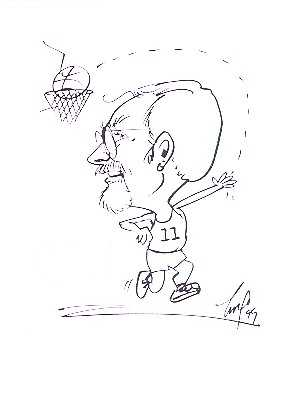
This morning was the kick-off of our annual Stewardship Campaign: four homilies from the four members of our ministerial "team" -- myself, the Minister of Music, and the two part-time ministers who were brought in to support me after I was diagnosed with cancer. That may sound like an awful lot of preaching, but it actually worked out magnificently...and without much advanced coordination between us either. Of course, today's service was really merely the mid-point of what has already been about six weeks worth of warm-up: planning, testimonials, the recruitment and training of visiting stewards, the preparation and mailing of our written materials, and (of course) the all-church fellowship event on Saturday night: an old-fashioned Bean Supper complete with corny entertainment and home-made pie. And now we can still look forward to another three to four weeks of home visits and face to face conversations, after which we should know how close we are to reaching our goal in these challenging economic circumstances.
As now both a part-timer and a short-termer myself, I haven't really paid that much attention to the finer details of the campaign this year. I don't even know what our canvass goal is, much less how likely we are to reach it based on our historical pledge numbers. I do know that the value of our endowment is down by about 30%, and have spoken personally with four different people who have either lost or left their jobs in the past few weeks. But I've also been told that we potentially have as many as sixty new pledgers this year, and this alone could easily make all the difference between success and disappointment. It's hard to say. There has been so much energy and good feeling around the church, really since the moment I arrived here two years ago, notwithstanding my eventual illness and diagnosis six months into this ministry. The way the members of this congregation rallied around me (and one another) was an authentic "George Bailey moment," and has both inspired and empowered a lot of people to get involved in ways they hadn't been involved with the church before. Attendance has been strong, with lots of first-time visitors every Sunday. So all those signs are very good.
But at the same time, the economic downturn has really put a damper on a lot of the things we dreamed of doing here. When I was candidating here two years ago, the air was filled with big plans for real estate expansion and partnerships with local arts, educational, and social justice organizations, and a much more visible footprint here at the head of Temple Street. Now it feels as if everyone is just hunkering down, and waiting to see how dark it's going to get before the dawn. And that, of course, has nothing to do with MY illness; it's just the sad and shameful legacy of eight years of plundering by the Bushies and their cronies. Meanwhile, now that my decision not to return here in the fall is public news, I'm starting to hear from all of the people for whom my ministry has made a big difference in their lives, who are sorry to see me going, who wish that I could stay, who tell me in just so many words what a huge inspiration I've been for them personally, and how much I have done for the church in such a short time. And naturally, it's hard for me to hear all that without beginning to second-guess myself, and falling into that trap of thinking that I'm indispensable, that no one can possibly do this job as well as I can, that by leaving now and denying this church the benefit of my vision, my experience, my enthusiasm, devotion and general excellence, I am in some way "leaving them in the lurch."
And whenever I start to feel this way, I just need to remind myself that we all THINK we're indispensable, but none of us really are, and that the fact that my departure may very well be setting them back a decade or more (as someone recently suggested to me) really means very little to a congregation which measures its lifespan in centuries. I'm proud of whatever I've been able to accomplish in my all-too-brief time here; I wish it could have been longer (as I think everyone does), but God-Providence-Destiny-the Universe had a different plan both for me and for them, and that's just the way it's got to be. And that's my mantra. None of us would have wished for this, and we can all mourn the loss of "what might have been." And I will miss them too once I'm gone. But let's take THIS time to say goodbye, and celebrate the time we had together, rather than squandering it with regret.
And if I ever find myself feeling TOO nostalgic, I just need to remind myself of these abominable Maine winters....
Meanwhile, if you are interested in what a minister in my situation might have to say to their congregation at Stewardship time, here are links to both my Stewardship Packet letter and my Sunday Morning kick-off homily. Enjoy!
Stewardship Letter
Stewardship Homily
Sunday, March 29, 2009
Thursday, March 26, 2009
Monkey Mindfulness
[Over at Monkey Mind, Providence Rhode Island minister James Ishmael Ford is writing about the role Joseph Campbell played in the renewal of the "spiritual" aspects of our Unitarian Universalist faith tradition. Here's a copy of the comment I posted there, which I'm posting here as well simply because it's such an easy thing to do.]
In 1978 I wrote my Senior Honors thesis at the University of Washington on Joseph Campbell's The Masks of God (a document now thankfully forever lost to posterity). The following year at HDS I continued to pursue those interests through coursework in Buddhism and the Buddhist/Christian dialogue, The Interpretation of Religious Experience, and James Fowler's theories of Faith Development.
My point is that even then -- a decade before the Moyers interviews -- some of us had already picked up on the idea of Unitarian Universalism as a "reasonable mysticism" -- a faith tradition which had grounded itself in science, "natural theology" and the other intellectual tools of the Enlightenment, but was still open to non-rational (as opposed to irrational) ways of knowing, and had a rich heritage of intuitive, "mystical" knowledge as well, "peak experiences" (in Maslow's terms) which could be described phenomenologically, and even recreated with some reliability through the use of certain kinds of time-tested techniques and practices.
Perry Miller's famous essay "From Jonathan Edwards to Emerson" makes almost this exact same point about Unitarianism's Enlightened Puritans and their Transcendentalist offspring, who looked back to their grandparents in order to re-embrace the emotional and spiritual intensity of that spirit-filled world. Finally, the work of (UU - although I didn't know it at the time) Frederick Streng on "Emptiness," along with the theories of German Sociologist of Religion Ernst Troeslsch (a major influence on James Luther Adams) about "Church," "Sect" and "Mysticism" as the three building blocks of Christian communities, helped me to pull a lot of these pieces together, at least in my own mind.
Our UU churches are places set apart (like a sect) from the rest of the world, where we can come to safely explore more deeply within ourselves (mysticism), and then return to the world with a redemptive, sacramental gift of grace (the Church) which has the power to transform the world....a cycle which (not coincidentally) exactly parallels Campbell's Heroic Journey. Anyway, that's how I learned it at Harvard, 30 years ago. Do you think I ought to ask for my tuition back?
In 1978 I wrote my Senior Honors thesis at the University of Washington on Joseph Campbell's The Masks of God (a document now thankfully forever lost to posterity). The following year at HDS I continued to pursue those interests through coursework in Buddhism and the Buddhist/Christian dialogue, The Interpretation of Religious Experience, and James Fowler's theories of Faith Development.
My point is that even then -- a decade before the Moyers interviews -- some of us had already picked up on the idea of Unitarian Universalism as a "reasonable mysticism" -- a faith tradition which had grounded itself in science, "natural theology" and the other intellectual tools of the Enlightenment, but was still open to non-rational (as opposed to irrational) ways of knowing, and had a rich heritage of intuitive, "mystical" knowledge as well, "peak experiences" (in Maslow's terms) which could be described phenomenologically, and even recreated with some reliability through the use of certain kinds of time-tested techniques and practices.
Perry Miller's famous essay "From Jonathan Edwards to Emerson" makes almost this exact same point about Unitarianism's Enlightened Puritans and their Transcendentalist offspring, who looked back to their grandparents in order to re-embrace the emotional and spiritual intensity of that spirit-filled world. Finally, the work of (UU - although I didn't know it at the time) Frederick Streng on "Emptiness," along with the theories of German Sociologist of Religion Ernst Troeslsch (a major influence on James Luther Adams) about "Church," "Sect" and "Mysticism" as the three building blocks of Christian communities, helped me to pull a lot of these pieces together, at least in my own mind.
Our UU churches are places set apart (like a sect) from the rest of the world, where we can come to safely explore more deeply within ourselves (mysticism), and then return to the world with a redemptive, sacramental gift of grace (the Church) which has the power to transform the world....a cycle which (not coincidentally) exactly parallels Campbell's Heroic Journey. Anyway, that's how I learned it at Harvard, 30 years ago. Do you think I ought to ask for my tuition back?
Wednesday, January 28, 2009
Swept Up By History -- Overwhelmed By Emotion
And good riddance to the Bushies! It's just so hard to describe how I feel about this transition of power. Eight years ago I witnessed Dubya accepting Gore's concession in front of the Texas State Legislature, and then leaving that building and stepping into a motorcade of Black SUVs...and in my gut I just knew that it was wrong, wrong, wrong... And now, eight years later, a very different Bush -- gray-haired, broken, pathetic -- leaves the Capitol by helicopter to return to Texas, with one last sentimental fly-over the White House before whatever awaits him next, which in my mind should be an obscure and dignified rustication in the wilderness of the Lone Star State, daily thanking God for a system of government that allows him that retirement, rather than turning him over to the World Court in flexicuffs and with a black bag over his head.
Make no mistake here: there has been a tremendous revolution in this country, two years in the making, which we seem to take for granted because the weight of our democratic traditions is so strong that it is hard to imagine it happening any other way. But from where I sit, the changes I see could not be more profound. It represents a complete transformation in the philosophy of governance, and a change-over in the control of the reins of power -- without violence or even the threat of violence, but rather via the ritualized recognition of the changed mandate of the people, and the voluntary surrender of power from those who once wielded it to those whom the people have chosen to replace them.
And already I can hear the Republican Noise Machine tuning up to talk about "the Obama Depression," blaming those who have held power for eight days for the mistakes and failed policies of those who misgoverned this country for the past eight years. But it's not going to work, because the people have seen the light and understand that it will be a long road back, even with all of us working and sacrificing together. The War on Terror, Global Warming, the Mortgage Crisis, Universal Health Care, rebuilding both the physical and the fiscal infrastructure of this country, and providing the next generation with the knowledge and skills they will need to compete in the global marketplace...not to mention the return of our civil and constitutional rights stripped away by the Patriot Act...it's a big agenda, but we can get it done. Embittered neofascist naysayers notwithstanding.
Make no mistake here: there has been a tremendous revolution in this country, two years in the making, which we seem to take for granted because the weight of our democratic traditions is so strong that it is hard to imagine it happening any other way. But from where I sit, the changes I see could not be more profound. It represents a complete transformation in the philosophy of governance, and a change-over in the control of the reins of power -- without violence or even the threat of violence, but rather via the ritualized recognition of the changed mandate of the people, and the voluntary surrender of power from those who once wielded it to those whom the people have chosen to replace them.
And already I can hear the Republican Noise Machine tuning up to talk about "the Obama Depression," blaming those who have held power for eight days for the mistakes and failed policies of those who misgoverned this country for the past eight years. But it's not going to work, because the people have seen the light and understand that it will be a long road back, even with all of us working and sacrificing together. The War on Terror, Global Warming, the Mortgage Crisis, Universal Health Care, rebuilding both the physical and the fiscal infrastructure of this country, and providing the next generation with the knowledge and skills they will need to compete in the global marketplace...not to mention the return of our civil and constitutional rights stripped away by the Patriot Act...it's a big agenda, but we can get it done. Embittered neofascist naysayers notwithstanding.
Friday, January 16, 2009
If the Matrix ran on Windows
Thought I'd make this random post, since it's been a couple of weeks since I've written anything here, and that really is way too long. So far though 2009 has been pretty laid back: preached once, paid some bills, had good news from my most recent CT scan (which you can read about at One Day Isle), and have generally just been digging out from underneath the holidays. Days have been bright but cold, and with the exception of one tough weekend following my most recent chemotherapy, my energy has been pretty good as well, despite the fact that I'm only generally sleeping now for two to three hours at a time.
Anyway, here's a cute little something from the folks at college humor about what it would be like if the Matrix ran on Windows.
Anyway, here's a cute little something from the folks at college humor about what it would be like if the Matrix ran on Windows.
Thursday, January 01, 2009
I'm so glad this wasn't MY wedding....
And I suspect other clergy will immediately empathize. I've had some strange things happen at weddings where I've been the officiant, often around the rings. One of my best moments was when a ring flew loose from the pillow where it had been tied, and I reached out and snatched it in mid-air like it was something I did every day, and handed it to the bride to place upon the groom's finger. And I've also been the victim of a practical joke, where the best man pretended to have forgotten the ring, and all of the attendants pretended to check their pockets until it was finally "discovered" at the end of the line. A very funny moment (and fortunately, they were my friends), but a challenge then to pull the service back to the proper level of solemnity before I pronounced them husband and wife.
And perhaps my best wedding story ever (again, for friends) -- officiating at a wedding for two white water rafting guides on a rock in the middle of the Skykomish River above Goldbar in Washington State. The plan was to pronounce them husband and wife, and put them in a raft to float down to the reception a few miles away, while the rest of us drove ahead to meet them for their big entrance as a married couple. Unfortunately, in the middle of August the water in the river was very low; HOURS later they finally arrived to greet their now-well-lubricated guests with the story of their journey -- "float fifty yards, then pull it over the rocks; float another fifty yards...." Yep Steve, That's Marriage! -- for better, for worse; for richer, for poorer; in sickness and in health; in sorrow and in joy.... At least you guys were dressed for the occasion.
Here's the URL for the video, just in case the embed isn't working....
http://www.youtube.com/watch?v=ga-ULeG09QY
Thursday, December 25, 2008
The Right to Bare Feet
I still haven't gotten around to writing my annual Holiday Letter, which seems a little redundant given the amount of blogging I've done this year. Still, it is a tradition I would hate to interrupt, and perhaps just that small and gentle contact...an e-mail with a link to the text of the actual letter itself -- will be sufficient. I sure have enjoyed the cards, letters and e-mails I've received from so many of you. One of my favorites actually contained the suggestion that in light of the recent events of December 14th in Bagdad, we need a new Constitutional Amendment protecting the right to Bare Feet.


And I actually thought Bush showed pretty good composure about all this. He recognizes now that he is the lamest of Ducks, and that he needs to take all this shoe-throwing in stride. And in some ways it's reassuring that he can still be the butt of a joke, and NOT take it too personally...one more reason for me NOT to want to turn him over to the World Court following Obama's Inauguration. I don't feel nearly so charitable toward Dick Cheney, or Donald Rumsfeld, or Roberto Gonzales. And good luck to Condi in what I imagine will be a four-year cat-fight with Sarah Palin for the heart and soul of what is left of the Republican Party.
And while I'm thinking about it, now that the shoe is on the other foot, let's also hope that the Democrats can keep it together for a change, rather than tearing their party apart bickering over the best seats in the big tent. Already the kerfuffle over Rick Warren offering the Invocation seems silly and ridiculous. I know there's a lot of Gay and Lesbian supporters of Obama who are outraged that such an outspoken proponent of Proposition 8 should be given such a prominent place at the swearing in of the next President. What I don't think they really appreciate though is the very high likelihood that Warren will eventually come around on this issue, just as so many of the rest of us have, once we became more familiar with it ourselves.


And I actually thought Bush showed pretty good composure about all this. He recognizes now that he is the lamest of Ducks, and that he needs to take all this shoe-throwing in stride. And in some ways it's reassuring that he can still be the butt of a joke, and NOT take it too personally...one more reason for me NOT to want to turn him over to the World Court following Obama's Inauguration. I don't feel nearly so charitable toward Dick Cheney, or Donald Rumsfeld, or Roberto Gonzales. And good luck to Condi in what I imagine will be a four-year cat-fight with Sarah Palin for the heart and soul of what is left of the Republican Party.
And while I'm thinking about it, now that the shoe is on the other foot, let's also hope that the Democrats can keep it together for a change, rather than tearing their party apart bickering over the best seats in the big tent. Already the kerfuffle over Rick Warren offering the Invocation seems silly and ridiculous. I know there's a lot of Gay and Lesbian supporters of Obama who are outraged that such an outspoken proponent of Proposition 8 should be given such a prominent place at the swearing in of the next President. What I don't think they really appreciate though is the very high likelihood that Warren will eventually come around on this issue, just as so many of the rest of us have, once we became more familiar with it ourselves.
Saturday, December 06, 2008
Excellence in Ministry
.jpg) Former pulpit of the 2nd Church in Boston, once used by Henry Ware Jr. and Ralph Waldo Emerson. Now located at the First Parish in Billerica Massachusetts.
Former pulpit of the 2nd Church in Boston, once used by Henry Ware Jr. and Ralph Waldo Emerson. Now located at the First Parish in Billerica Massachusetts.Over at iMinister and PeaceBang, my dear friends Christine and Vickie are hosting a conversation about Excellence in Ministry. It's a topic I have no little interest in myself, and so even though I can't really spare the time, I thought I'd toss in at least two cents worth now.
1. I'm one of those anachronisms who enrolled in seminary (Harvard Divinity) immediately after graduating from college, and who had completed my degree, seen the MFC and been ordained by the congregation where I did my field education (the 1st & 2nd Church in Boston) all before my 25th birthday. Of course, no one in their right mind was going to trust a newly-minted 24-year-old preacher with a pulpit of his own, so I ended up spending ANOTHER two years in graduate school studying creative writing and working as a Residence Hall Director, before being offered a year-long position as an intern assistant minister at my "home" church (University Unitarian Church in Seattle), and eventually receiving a call to a pulpit of my own (Midland, Texas) the week I turned 28.
2. Since that time, I have (for the most part) enjoyed a somewhat eclectic up-and-down career which has included work as an extension minister/new congregation organizer, half-a-dozen part-time consulting ministries, some time away from ministry managing a bookstore (while my now-ex-wife attended Law School), an earned PhD of my own (in American History) along with an interdisciplinary Masters Degree (my third, if you're counting) in American Studies, plus work as a graduate teaching fellow (and on occasion a visiting adjunct professor) in the fields of English/Creative Writing, Philosophy, Religious Studies (I was Marcus Borg's personal teaching assistant) and, of course, History. In addition I spent a semester abroad in Denmark as a visiting doctoral student at Aalborg University's "School for Postgraduate Interdisciplinary Research in Interculturality and Transnationalism" (SPIRIT), and since completing my dissertation in 2001 have served a two-year interim ministry on Nantucket Island, a four-year settled ministry in Carlisle Massachusetts, and am now in my second year of a settled ministry at the First Parish in Portland Maine. So I come to this topic with no shortage of either credentials or experience, as well as a perspective that is no doubt quite different from that of someone about my age (or even a decade or two younger) who is currently working in a secular vocation, but still dreaming about becoming a minister when they grow up.
3. So having said all that, let me enter the conversation. People seem to want to argue that there is more than one path into the ministry, and that these paths need to be honored and respected more than they are. With that I can agree. But then they also seem to want to assert that "all ministries are equal," and I'm not so sure that I can agree with that. All these credentials are not just about some additional letters behind my name; they represent real work, real learning, and real achievement which were specifically focused on improving my competence and qualifications for the ministry itself. It's not that I want to discount the achievements of those who are working in other fields, and in effect bringing their "transferable skills" with them. I would suggest, however, that sometimes these "imports" do more harm than good, in that they tend to displace a long and subtle history of ecclesiastical tradition with the "values of the marketplace" in ways that are often inappropriate and damaging to the health of the institution.
4. There also seems to be a lot of complaining about attitudes of ministerial "privilege," and the sense of entitlement that comes from having successfully leapt through all the "hoops." And with this I agree entirely - I think it is one of the most potentially damaging challenges our profession faces, and the sooner we can cure ourselves of it the better. Ministry is indeed a "privilege" -- it's an honor indivduals bestow upon us one at a time by trusting us enough to let us be "their minister;" it is a kind of authority which can take a lifetime to accumulate, and can be squandered in an instant. So notwithstanding all of the letters behind my own name, I am a profound believer in the principle that "All Ministry is Local," and that the credentials themselves are essentially meaningless, and valuable only to the extent that earning them has in some way helped me to become a better minister in the process.
5. Speaking of hoops (the burning, not the basketball kind) and the jumping through thereof, I certainly have a lot of empathy for those who still have that process in front of them, rather than well behind them (as I do). But let's face it, some sort of advance credentialling or process of "approbation" is essential to ANY profession, and perhaps especially essential to one like ours, which unlike either of the other two "learned" professions (law and medicine) typically brings the practitioner into their full responsibilities right on day one, in an environment where they typically work alone without much opportunity for supervision, external accountability, or daily mentoring by a more experienced, senior colleague. Even our internship process is awkward, since it tends to train ministers in large, multi-staff situations only to prepare them poorly for the kinds of expectations they will experience in the small "family" or "pastoral" sized churches where they are most likely to be called. A good portion of the second chapter of my doctoral dissertation is devoted to the history of the Approbation process in our movement, beginning in Puritan times and continuing into the 19th century. Interestingly enough, we still examine our candidates according to the same basic criteria as the Puritans: Competence, Character, and Commitment to the Faith. I don't think these are bad criteria at all. The big questions are how do we define "Competence" and what do we mean by "Commitment?" Character is always going to be a judgement call. Better the MFC though than leaving it up to self-selection, or even the judgement of local search committees (amateurs for whom it is literally a once-in-a-lifetime experience).
6. Another big complaint: the cost of seminary and the amount of debt it often places on newly-minted ministers entering a profession notorious for its low, flat and static levels of compensation. I was lucky, I guess -- between a combination of work, scholarships, and frugal living, I was able to graduate from Harvard (in 1981) with a debt of only $7000. Since I had no college debt at that point either (hurrah for in-state tuition at an excellent public university!), and was able to get through that second MA in Creative Writing with only another $2500 in additional borrowing, I finished my first incarnation as a student with a very reasonable debt load, despite a starting salary in my first settlement of only $30k (TCM. S/H was probably closer to $22k).
In my second incarnation it was a similar story - the teaching fellowships, a few grants (including one from the UU Scholars program), and my work as a part-time consulting minister essentially paid my tuition and kept me debt free, even though my spouse's income as a trial lawyer was perfectly sufficient to support our entire family. So while I feel I understand the concern that midlife career changers might feel about the cost of seminary (and it's corresponding debt load) in comparison to the level of earnings one can anticipate upon completion of the degree, I'm not especially sympathetic either. No one has a "right" to become a UU minister simply because they are "feeling the call," and likewise the decision to pursue a theological education does not necessarily entitle someone to have that education paid for by someone else. I think some combination of competitive, merit-based scholarships together with a systematic process to help ministers who agree to serve small, struggling congregations with denominational assistance in repaying their student loans is still the best strategy.
But this understanding also needs to be linked with a much more intentional method for ministerial development other than mere self-discernment, as well as the more fundamental understanding that NO ONE SHOULD UNDERTAKE ADVANCED THEOLOGICAL STUDY WITHOUT BEING WILLING TO DO SO FOR THE SAKE OF KNOWLEDGE AND SELF-IMPROVEMENT ALONE, AND WITH THE FULL UNDERSTANDING THAT IT MAY NEVER LEAD TO AN ACTUAL "PAYING" JOB IN THE MINISTRY! As for the question of whether or not a seminary education is really essential to being an effective Parish Minister, I would have to say both yes and no. On one hand, there is certainly plenty of "ministry" that can happen in a parish that anyone with a good heart, a sincere commitment, and a certain level of on-the-job training can do perfectly competently. But "doing" ministry and "being" a minister are two very different things. I'm happy to "share" the work of ministry as broadly as possible; in fact, it's an important part of what every minister should do to equip and prepare their people for wider service. But before I'm willing to let someone call themselves my "colleague," and to claim for themselves all of the so-called "rights and privileges" attendant to that status, I want to KNOW that they have gone through a thorough and rigorous program of advanced academic study, and are intellectually prepared to understand and represent the finer points of our theological and ecclesiastical traditions. Perhaps more to the point, I want to know that they were willing to make the same kinds of personal and financial sacrifices that I was willing to make, and that their commitment to the ministry is about something more profound than merely a title and a paycheck.
7. Finally (yes, finally...at least for now) there was an interesting point raised by someone about "suspicion" of Excellence in Ministry, and whether or not our congregations are really well prepared to cope with a truly excellent and (by association) ambitious minister. I have several thoughts about this. First, it does often seem to me that many of our congregations (especially small, "stuck" ones) are operating under the informal syllogism that "Knowledge is Power," and "Power Corrupts;" therefore We must Disempower the Knowledgeable in order to Prevent them from Corrupting our Democratic Process. Top-down leadership often doesn't fly in our movement; instead it results in a rapid nose-dive followed by a dramatic crash-and-burn. This is a VERY hard lesson to learn: that churches tend to move "at the speed of church," and that Patience, Persistence, Tenacity and Commitment to a Larger Vision are often far more important to success than mere brilliance and hard work alone. For clergy, the church is not only a livelihood, it is also a lifestyle; we are (or should be) committed to our vocation 24/7/365, and even when we are disciplined about taking a regular day off, we don't stop "being" a minister even for a moment. Yet for most lay people, a 3-5 hour/week commitment to their faith community is extraordinary, while 3-5 hours/month is probably far closer to the norm. Achieving excellence (and with it, "success") has somewhat different rules in this kind of work environment. The ability to work with people, to leverage their efforts rather than wasting their time, to organize the tasks into manageable "bites" and to battle frustration and discouragement with encouraging words and visible progress...in a word, to build and coach a team rather than trying to do it all by oneself.... this is the real key to Excellence in Ministry in the 21st century, so far as I can see it. How well does this match up with what other folks are seeing in their situations?
Thursday, December 04, 2008
Is it a Phoenix or an "Obama?"
I've never met Robin E*****, the so-called self-titled (not to mention self-appointed) "Emerson Avenger," and frankly I hope never to have the pleasure. I know him by reputation, of course, as I suspect so many other bloggers do here in the UU blogosphere, but since I generally find his posts kind of abrasive and unpleasant, mostly I just try to ignore him in the hope that our paths through cyberspace will cross as little as possible.
Yet lately for some reason he has chosen to take a shine to me again, this time even going so far as accusing me of plagiarism because he apparently ALSO saw the image of the Demographic Map of the United States of America plotting the outcome of the last election in shades of Blue and Red based on the percentage of the popular vote, and "normalized" geographically for population density I wrote about in a previous post, and it also reminded him of a Phoenix.
But before we go too far together down THAT road Brother E******, let me offer you a basic tutorial in communications law for working writers.
Plagiarism is essentially defined as "the purloining of literary work." [Gotta LOVE THAT definition! -- it pretty much just says it all...] Simply having a similar idea based on a similar response to a shared source of inspiration is in no way, shape or form ANYTHING resembling actual plagiarism; it is simply a demonstration that not only do great minds think alike, but sometimes even great minds and not-so-great minds can have similar thoughts...the difference being that a Truly Great Mind recognizes that there is simply "something in the air," while the not-so-great mind foolishly (and some might say narcissistically) mistakes the obvious for their own unique and original thought.
But to bring this back to the topic at hand, writers cannot copyright "ideas" -- they may only copyright a unique and original expression of an idea -- in other words, actual and specific language and phrasing which embody and express a unique perspective of a shared (or private) inspiration, which in turn could then be plagiarized by someone else who saw that unique expression, "purloined" (i.e. stole or copied) it, and then attempted to pass it off (obviously without attribution) as their own work. An even more basic point is that in almost ALL cases an actual plagiarist has to have actually SEEN the original work in order to "steal" it. You can't really copy something you've never even read.
As both an academic and a clergyman I tend to take allegations of plagiarism fairly seriously, since in many ways it strikes at the core of everything I believe about integrity and creativity and their importance to the human soul. On the other hand, I also tend to take a fairly broad and "liberal" view of "fair use;" we are, after all, called upon to Proclaim the Good News, not to copyright it. Yet to palm off someone's original work as your own, when tools like the internet make it so easy these days to find and attribute almost anything, is truly shameful. But if you look back at what I've actually written, you'll notice right away that I've done nothing of the sort.
Quickly now - if you look at MY original post, you'll notice that not only do I compare this image to a Phoenix, I also compare it to the Holy Spirit (in the form of a Dove, as in Luke's Gospel), and make several other references to other aspects of our shared cultural mythology, before finally getting around to making the one statement that might indeed be potentially copyrightable, and name this bird a "Barack." Again, not a particularly obscure idea; it could have occurred to anyone. But it just so happened to occur to me -- and it is unique, and it is original, and as far as I'm concerned, folks can copy it as much as they like (although a little honest attribution is always welcome....)
Yet lately for some reason he has chosen to take a shine to me again, this time even going so far as accusing me of plagiarism because he apparently ALSO saw the image of the Demographic Map of the United States of America plotting the outcome of the last election in shades of Blue and Red based on the percentage of the popular vote, and "normalized" geographically for population density I wrote about in a previous post, and it also reminded him of a Phoenix.
But before we go too far together down THAT road Brother E******, let me offer you a basic tutorial in communications law for working writers.
Plagiarism is essentially defined as "the purloining of literary work." [Gotta LOVE THAT definition! -- it pretty much just says it all...] Simply having a similar idea based on a similar response to a shared source of inspiration is in no way, shape or form ANYTHING resembling actual plagiarism; it is simply a demonstration that not only do great minds think alike, but sometimes even great minds and not-so-great minds can have similar thoughts...the difference being that a Truly Great Mind recognizes that there is simply "something in the air," while the not-so-great mind foolishly (and some might say narcissistically) mistakes the obvious for their own unique and original thought.
But to bring this back to the topic at hand, writers cannot copyright "ideas" -- they may only copyright a unique and original expression of an idea -- in other words, actual and specific language and phrasing which embody and express a unique perspective of a shared (or private) inspiration, which in turn could then be plagiarized by someone else who saw that unique expression, "purloined" (i.e. stole or copied) it, and then attempted to pass it off (obviously without attribution) as their own work. An even more basic point is that in almost ALL cases an actual plagiarist has to have actually SEEN the original work in order to "steal" it. You can't really copy something you've never even read.
As both an academic and a clergyman I tend to take allegations of plagiarism fairly seriously, since in many ways it strikes at the core of everything I believe about integrity and creativity and their importance to the human soul. On the other hand, I also tend to take a fairly broad and "liberal" view of "fair use;" we are, after all, called upon to Proclaim the Good News, not to copyright it. Yet to palm off someone's original work as your own, when tools like the internet make it so easy these days to find and attribute almost anything, is truly shameful. But if you look back at what I've actually written, you'll notice right away that I've done nothing of the sort.
Quickly now - if you look at MY original post, you'll notice that not only do I compare this image to a Phoenix, I also compare it to the Holy Spirit (in the form of a Dove, as in Luke's Gospel), and make several other references to other aspects of our shared cultural mythology, before finally getting around to making the one statement that might indeed be potentially copyrightable, and name this bird a "Barack." Again, not a particularly obscure idea; it could have occurred to anyone. But it just so happened to occur to me -- and it is unique, and it is original, and as far as I'm concerned, folks can copy it as much as they like (although a little honest attribution is always welcome....)
Tuesday, December 02, 2008
What Have You Done in your Life? a meme
What have you done in your life? -- A meme I found on a couple other blogs. (What I've done is in bold, with comments in the parentheses) To play, copy the following list. Bold the things you've done. Post on your own blog...
Started my own blog
Slept under the stars
Played in a band
Visited Hawaii [but I hope to before I die]
Watched a meteor shower
Given more than I can afford to charity (except obviously, I COULD afford it)
Been to Disneyland/world
Climbed a mountain (but it wasn't really MUCH of a mountain - not like Hood or Rainier, for instance)
Held a praying mantis
Sung a solo (during a "cafe night" on Nantucket. "Hey there. You with the stars in your eyes....")
Bungee jumped
Visited Paris
Watched lightning at sea (although I was still on the land)
Taught myself an art from scratch (from SCRATCH?)
Adopted a child
Had food poisoning
Walked to the top of the Statue of Liberty
Grown my own vegetables (and hope to again, someday)
Seen the Mona Lisa in France
Slept on an overnight train
Had a pillow fight
Hitchhiked
Taken a sick day when not ill (unless we're counting mental health)
Built a snow fort
Held a lamb
Gone skinny dipping
Run a marathon
Ridden in a gondola in Venice (could have if I'd wanted to)
Seen a total eclipse
Watched a sunrise or sunset
Hit a home run
Been on a cruise (but I'm planning to soon. Possibly as soon as this summer)
Seen Niagara Falls in person (planning to do this soon too, and also visit the Hall of Fame in Cooperstown)
Visited the birthplace of my ancestors
Seen an Amish community (this may happen soon too)
Taught myself a new language (although not very well. I'm still learning though)
Had enough money to be truly satisfied (satisfaction is such a subjective thing)
Seen the Leaning Tower of Pisa in person
Gone rock climbing
Seen Michelangelo's David
Sung karaoke (and now, admitted it)
Seen Old Faithful geyser erupt
Bought a stranger a meal at a restaurant
Visited Africa (again, maybe as part of my cruise)
Walked on a beach by moonlight
Been transported in an ambulance
Had my portrait painted (now THERE'S a great idea. Does a caricature count?)
gone deep sea fishing
Seen the Sistine Chapel in person
Been to the top of the Eiffel Tower in Paris (again, could have if I'd wanted to. I'd rather look AT it than down from it)
Gone scuba diving or snorkeling (my ex was the diver. I have used a snorkel though)
Kissed in the rain
Played in the mud
Gone to a drive-in theater
Been in a movie
Visited the Great Wall of China
Started a business (unless you think of a ministry as a "business")
Taken a martial arts class
Visited Russia
Served at a soup kitchen
Sold Girl Scout Cookies (But I've sure bought plenty in my day!)
Gone whale watching (I've seen some though)
Gotten flowers for no reason
Donated blood, platelets or plasma
Gone sky diving
Visited a Nazi concentration camp
Bounced a check (but it wasn't my fault - the check TO ME bounced first)
Flown in a helicopter
Saved a favorite childhood toy
Visited the Lincoln Memorial
Eaten caviar
Pieced a quilt (let's say, HELPED piece a quilt)
Stood in Times Square
Toured the Everglades
Been fired from a job
Seen the Changing of the Guard in London
Broken a bone (not even a finger. Can you believe it?)
Been on a speeding motorcycle (don't tell my mother
Seen the Grand Canyon in person
Published a book (this is actually in the process of happening now. A long, SLOW process....)
Visited the Vatican
Bought a brand new car (but now I can't drive it...)
Walked in Jerusalem
Had my picture in the newspaper
Read the entire Bible
Visited the White House (just the outside)
Killed and prepared an animal for eating (Hummmm... maybe after I've held the lamb, I can...)
Had chickenpox
Saved someone's life (they probably would have lived anyway)
Sat on a jury (no competent lawyer is ever going to let ME on a jury...)
Met someone famous
Joined a book club
Lost a loved one
Had a baby
Seen the Alamo in person
Swam in the Great Salt Lake
Been involved in a law suit
Owned a cell phone
Been stung by a bee
Ridden an elephant (but I'd like to before I die)
Chalice Chick's additions:
Read all three volumes of the Lord of the Rings
(multiple times)
Visited the Taj Mahal
Performed in a dance recital
Been on horseback while the horse jumped over something
Won an athletic competition
Gotten a straight-A report card
Prayed to Zeus
Watched news coverage, rapt, to see what was going to happen
Gotten lost in a building more than 500 years old
Kissed somebody milliseconds before bells started to ring. (well, maybe not "milliseconds")
Joel Monka’s additions:
Made love in a moving vehicle (again, if boats count)
Created something you know you'll never better (let's say, suspect I will never better)
Held a pet while they died (just this past October 4th)
Walked the Promenade Des Anglaises in Nice. (and it was...Nice)
Patrick Murfin's additions:
Graduated from college
Been in Prison (well, not as a prisoner)
Written the Great American Novel (it is neither great, nor technically a novel...but it is American. "My life's the poem I would have writ, but I could not both live and utter it.")
Ridden the rails (used to daydream about this quite a bit, but I'm way too old for it now. And times have changed....)
Seen that Alaska (despite having grown up in Seattle, the gateway to "the Last Frontier.")
Been booed and/or heckled (in church, no less)
Been elected to public office (unless Vice President of one's High School Student Government counts...)
Started my own blog
Slept under the stars
Played in a band
Visited Hawaii [but I hope to before I die]
Watched a meteor shower
Given more than I can afford to charity (except obviously, I COULD afford it)
Been to Disneyland/world
Climbed a mountain (but it wasn't really MUCH of a mountain - not like Hood or Rainier, for instance)
Held a praying mantis
Sung a solo (during a "cafe night" on Nantucket. "Hey there. You with the stars in your eyes....")
Bungee jumped
Visited Paris
Watched lightning at sea (although I was still on the land)
Taught myself an art from scratch (from SCRATCH?)
Adopted a child
Had food poisoning
Walked to the top of the Statue of Liberty
Grown my own vegetables (and hope to again, someday)
Seen the Mona Lisa in France
Slept on an overnight train
Had a pillow fight
Hitchhiked
Taken a sick day when not ill (unless we're counting mental health)
Built a snow fort
Held a lamb
Gone skinny dipping
Run a marathon
Ridden in a gondola in Venice (could have if I'd wanted to)
Seen a total eclipse
Watched a sunrise or sunset
Hit a home run
Been on a cruise (but I'm planning to soon. Possibly as soon as this summer)
Seen Niagara Falls in person (planning to do this soon too, and also visit the Hall of Fame in Cooperstown)
Visited the birthplace of my ancestors
Seen an Amish community (this may happen soon too)
Taught myself a new language (although not very well. I'm still learning though)
Had enough money to be truly satisfied (satisfaction is such a subjective thing)
Seen the Leaning Tower of Pisa in person
Gone rock climbing
Seen Michelangelo's David
Sung karaoke (and now, admitted it)
Seen Old Faithful geyser erupt
Bought a stranger a meal at a restaurant
Visited Africa (again, maybe as part of my cruise)
Walked on a beach by moonlight
Been transported in an ambulance
Had my portrait painted (now THERE'S a great idea. Does a caricature count?)
gone deep sea fishing
Seen the Sistine Chapel in person
Been to the top of the Eiffel Tower in Paris (again, could have if I'd wanted to. I'd rather look AT it than down from it)
Gone scuba diving or snorkeling (my ex was the diver. I have used a snorkel though)
Kissed in the rain
Played in the mud
Gone to a drive-in theater
Been in a movie
Visited the Great Wall of China
Started a business (unless you think of a ministry as a "business")
Taken a martial arts class
Visited Russia
Served at a soup kitchen
Sold Girl Scout Cookies (But I've sure bought plenty in my day!)
Gone whale watching (I've seen some though)
Gotten flowers for no reason
Donated blood, platelets or plasma
Gone sky diving
Visited a Nazi concentration camp
Bounced a check (but it wasn't my fault - the check TO ME bounced first)
Flown in a helicopter
Saved a favorite childhood toy
Visited the Lincoln Memorial
Eaten caviar
Pieced a quilt (let's say, HELPED piece a quilt)
Stood in Times Square
Toured the Everglades
Been fired from a job
Seen the Changing of the Guard in London
Broken a bone (not even a finger. Can you believe it?)
Been on a speeding motorcycle (don't tell my mother
Seen the Grand Canyon in person
Published a book (this is actually in the process of happening now. A long, SLOW process....)
Visited the Vatican
Bought a brand new car (but now I can't drive it...)
Walked in Jerusalem
Had my picture in the newspaper
Read the entire Bible
Visited the White House (just the outside)
Killed and prepared an animal for eating (Hummmm... maybe after I've held the lamb, I can...)
Had chickenpox
Saved someone's life (they probably would have lived anyway)
Sat on a jury (no competent lawyer is ever going to let ME on a jury...)
Met someone famous
Joined a book club
Lost a loved one
Had a baby
Seen the Alamo in person
Swam in the Great Salt Lake
Been involved in a law suit
Owned a cell phone
Been stung by a bee
Ridden an elephant (but I'd like to before I die)
Chalice Chick's additions:
Read all three volumes of the Lord of the Rings
(multiple times)
Visited the Taj Mahal
Performed in a dance recital
Been on horseback while the horse jumped over something
Won an athletic competition
Gotten a straight-A report card
Prayed to Zeus
Watched news coverage, rapt, to see what was going to happen
Gotten lost in a building more than 500 years old
Kissed somebody milliseconds before bells started to ring. (well, maybe not "milliseconds")
Joel Monka’s additions:
Made love in a moving vehicle (again, if boats count)
Created something you know you'll never better (let's say, suspect I will never better)
Held a pet while they died (just this past October 4th)
Walked the Promenade Des Anglaises in Nice. (and it was...Nice)
Patrick Murfin's additions:
Graduated from college
Been in Prison (well, not as a prisoner)
Written the Great American Novel (it is neither great, nor technically a novel...but it is American. "My life's the poem I would have writ, but I could not both live and utter it.")
Ridden the rails (used to daydream about this quite a bit, but I'm way too old for it now. And times have changed....)
Seen that Alaska (despite having grown up in Seattle, the gateway to "the Last Frontier.")
Been booed and/or heckled (in church, no less)
Been elected to public office (unless Vice President of one's High School Student Government counts...)
Thursday, November 27, 2008
Can You Name This Creature?

It looks almost like a Phoenix, doesn't it? - rising from the ashes of something that has been burnt in its entirity (holocaust?), yet carrying with it both the vow of "never again," and the promise of a new and wiser beginning. Or perhaps it's a dove, or the spirit in the form of a dove, rising into heaven, where it might "stand again" (anastasis?) and inspire others to follow and embody it whever they are led.
[And my sincere apologies to those of you who object on theological grounds to my comparing these two terms (and these two birds); it's not intended as a profound theological statement or profession of doctrine - it is simply a random association of two etymologies with two familiar myths, or a familiar myth and a horrifying truth, or two "truths," or...]
But before we go much further, what it actually just so happens to be (and I think I have this right) is a Demographic Map of the United States of America plotting the outcome of the last election in shades of Blue and Red based on the percentage of the popular vote, and "normalized" geographically for population density.
This is the bird that bears on its back the burden of all of our dreams and hopes and expectations.
This is the Creature which we have created by Word Alone: by breathing OUR Spirit over the face of the Deep, and hoping it will be good.
It is a cultural Rorschach of the Spirit of the Age, a reflection of the Archetype of the Zeitgeist.
I dunno. Whaddya say we call it a "Barack?"
Monday, November 24, 2008
From "An Essay on Man" by Alexander Pope
Know then thyself, presume not God to scan,
The proper study of mankind is Man.
Placed on this isthmus of a middle state,
A being darkly wise and rudely great:
With too much knowledge for the Sceptic side,
With too much weakness for the Stoic's pride,
He hangs between, in doubt to act or rest;
In doubt to deem himself a God or Beast;
In doubt his mind or body to prefer;
Born but to die, and reas'ning but to err;
Alike in ignorance, his reason such,
Whether he thinks too little or too much;
Chaos of thought and passion, all confused;
Still by himself abused or disabused;
Created half to rise, and half to fall:
Great lord of all things, yet a prey to all;
Sole judge of truth, in endless error hurl'd;
The glory, jest, and riddle of the world!
The proper study of mankind is Man.
Placed on this isthmus of a middle state,
A being darkly wise and rudely great:
With too much knowledge for the Sceptic side,
With too much weakness for the Stoic's pride,
He hangs between, in doubt to act or rest;
In doubt to deem himself a God or Beast;
In doubt his mind or body to prefer;
Born but to die, and reas'ning but to err;
Alike in ignorance, his reason such,
Whether he thinks too little or too much;
Chaos of thought and passion, all confused;
Still by himself abused or disabused;
Created half to rise, and half to fall:
Great lord of all things, yet a prey to all;
Sole judge of truth, in endless error hurl'd;
The glory, jest, and riddle of the world!
Tuesday, November 18, 2008
Why Do You Ewes Use "UUs?"
I have to admit, as ackward and tongue-twisting as "Unitarian Universalsm" may be, it is infinitely preferable to the acronym "UU." And I don't even want to think about the connotations of "UUism," much less "Unitarian Universalist TM." This whole on-going discussion about whether or not UUism is a form a liberal Christianity, a post-Christian Protestant heresy (open, of course, to inspiration from ALL the world's great religious traditions), or actually an entirely New Religion altogether seems as pointless to me as the seemingly interminable debates about whether or not certain semi-obscure celebrities from a century or two ago ever actually "signed the book." But here's my larger point....
So many of these discussions seem to boil down to anxiety about identity, legitimacy, and a desire for better "branding." And with that anxiety and that desire comes a whole history of baggage around issues of anti-creedalism and freedom of conscience, together with both a perceived need and a profound reluctance to articulate "Things Most Commonly Believed Among Us To-Day." And this reflects yet another tension at the center of our movement: our understanding that "all ministry is local," and that the proper location of the authentic religious/spiritual life is within a covenanted local congregation and community, and the ambition to develop a higher public profile, grow in numbers and influence, and become a more powerful presence on the religious landscape.
So with all that water now under the bridge (at least until the tide turns again), here's something that I've often wondered about, and in particular have been wondering about again lately. Despite the great pride we take in being "a church without a creed," we are the ONLY denomination I can think of off the top of my head that takes its name from two explicitly theological doctrines: Unitarianism = a belief that God is One (i.e. radical monotheism, and more explicitly the rejection of the doctrine of the Trinity) and Universalism = a belief that All Souls shall ultimately be reconciled to their Creator (i.e. Universal Salvation: the "no Hell" church). So here's my Question: can one be a good "UU" and still find meaning in the doctrine of the Trinity (never mind Pantheism, or its opposite Atheism), or believe that SOME souls, at least, are going to Hell, and deservedly so?
Just a few random thoughts, after having just finished teaching for the God Only Knows just how many times the "UU Identity" portion of our "New UU Explorers Class."
So many of these discussions seem to boil down to anxiety about identity, legitimacy, and a desire for better "branding." And with that anxiety and that desire comes a whole history of baggage around issues of anti-creedalism and freedom of conscience, together with both a perceived need and a profound reluctance to articulate "Things Most Commonly Believed Among Us To-Day." And this reflects yet another tension at the center of our movement: our understanding that "all ministry is local," and that the proper location of the authentic religious/spiritual life is within a covenanted local congregation and community, and the ambition to develop a higher public profile, grow in numbers and influence, and become a more powerful presence on the religious landscape.
So with all that water now under the bridge (at least until the tide turns again), here's something that I've often wondered about, and in particular have been wondering about again lately. Despite the great pride we take in being "a church without a creed," we are the ONLY denomination I can think of off the top of my head that takes its name from two explicitly theological doctrines: Unitarianism = a belief that God is One (i.e. radical monotheism, and more explicitly the rejection of the doctrine of the Trinity) and Universalism = a belief that All Souls shall ultimately be reconciled to their Creator (i.e. Universal Salvation: the "no Hell" church). So here's my Question: can one be a good "UU" and still find meaning in the doctrine of the Trinity (never mind Pantheism, or its opposite Atheism), or believe that SOME souls, at least, are going to Hell, and deservedly so?
Just a few random thoughts, after having just finished teaching for the God Only Knows just how many times the "UU Identity" portion of our "New UU Explorers Class."

Tuesday, November 11, 2008
Friday, November 07, 2008
...and the home of the brave....
Yes. "Free at last, free at last, Great God Almighty, we are free at last." And I'm not really certain whether we should Praise God, that Supreme, Divine Being Who gives us life and gives life meaning...or simply thank our lucky stars...but this has sure been a very special week all over the world. And despite the incredible amount of chaos that still seems to reign over much of reality, I feel as if we all at last have at least turned a corner.
Now comes the TRULY hard work -- the challenge of coming together, agreeing on our priorities, defining our objectives, goals and desired outcomes, allocating our resources to match those priorities, and doing the work that needs to be done. Just doing the work. Believe me, there is plenty of work to go around for everyone. I hardly know where to begin.
Now comes the TRULY hard work -- the challenge of coming together, agreeing on our priorities, defining our objectives, goals and desired outcomes, allocating our resources to match those priorities, and doing the work that needs to be done. Just doing the work. Believe me, there is plenty of work to go around for everyone. I hardly know where to begin.
Thursday, October 16, 2008
Too Scary for Words

Yes, this is an actual, legitimate, unphotoshopped photograph from last night's debate, showing EXACTLY what it appears to show: the decrepit old (white) Man Who Would Be President sticking his tongue out and (pretending to be?) grabbing at the ass of the handsome and articulate young (black) Man Who SHOULD Be President. And I hope this image surges through the media the same way that the Dukakis tank commander photo or Howard Dean's "Scream" did...but I doubt it will. It's the sort of photo that is easily ignored: no sound, no movement -- just a moment of still photography easily explained away as "a misdirected old man who got confused and was heading off stage in the wrong direction." Which sort of fits the overall theme of the McCain Campaign these days anyway.
I actually thought McCain did pretty well last night: didn't foam at the mouth, kept his temper, put Obama on the defensive with his carefully-crafted (and unrebuttable) innuendo, and basically seized control of both the tempo and the direction of the debate by ignoring the moderator and butting in whenever he felt like it. Played the race/age/experience card for all it was worth: a seasoned, well-tested (white) "Maverick" vs. the "eloquent," smooth-talking and good-looking but relatively unknown (and unfamiliar BLACK) "tax and spend" liberal. But at the end of the day, it was still the same old tired words out of the mouth of a washed-up, over-the-hill politician desperate for his crack at four years of unprecedented executive power.
I was, although, particularly entertained when McCain used a variation of the same line I suggested Al Gore should have used when Bush attempted to link him to the various Clinton scandals back in 2000: "that was the fella who beat your daddy; you have to run against ME." God how I wish Gore had won that election -- or should I say, fought harder to prevent the Bushies from STEALING that election. What a different world we would be living in now....
And it is still my fantasy that as George W. Bush exits the Inaugural Platform next January, it will be into the waiting arms of representatives of the World Court, who will then escort him to his holding cell in the Hague. And of course my great fear is that there will be no Inauguration -- that after the fiasco of THIS election (and God only knows what may happen next) the Bushies will fabricate some desperate excuse for holding on to power, and enforce it by military means.
Do we really want to see tanks in the streets of Washington DC? They say it could never happen here. But you know, recently I've seen a LOT of things folks said could never happen here. And while some have been good, some others have been not so good as well.
I guess a couple of other quick thoughts before I sign off, since I post here so infrequently as it is. I'm really concerned that we need not just an Obama victory, but an Obama landslide for this election to really create the mandate that Obama needs to effect meaningful change: a huge margin in both the electoral and the popular vote, plus solid majorities in both Houses, and strong showings in local elections as well. We need to sweep aside every last remnant of Karl Rove's vision of a "permanent Republican majority," and reinstate the more tolerant and diverse "liberal" family values based on civility, mutual concern, and the larger public good.
But beyond that, we will be laying a tremendous burden of expectation upon the shoulders of a single individual -- more than any one individual can possibly bear, I think. And so we all need to be willing to step up and to sacrifice in order to create the change we need. Sacrifice = to make sacred. It's OK if we all share it. But the plutocratic "croney capitalism" of the past eight years has GOT to end. And steps need to be taken to return that unprecedented concentration of wealth back to ALL the American people, so that it might be used for the common good.
And at the same time, given the Bush administration's unapologetic attempts to concentrate power in the hands of the Executive Branch, and the apparent NEED for that kind of power the next administration will claim it needs in order to undo the mess the Bushies have created, is there ANY politician on the Planet who could possibly be convinced to LET GO of that power once the essential tasks have been accomplished. We need a Cincinnatus, and not a Caesar. George Washington understood that. I think even Michael Dukakis did. But do you really think that Sarah Palin has even a CLUE to what I'm talking about?

Saturday, September 27, 2008
The Politics of Spectacle and Distraction
Last month I blogged on this site comparing Sarah Paliln's selection as the Republican Vice Presidential candidate to the Harriet Meiers nomination to the Supreme Court, and suggested that within the week the Alaskan Hockey Mom would gracefully withdraw from the ticket, having done her job of confusing an ever-more fickle electorate and distracting attention from the real issues in these critical last few weeks before voters finally go to the polls. LINK to Original Post here (be sure to scroll down through the comments).
Now here comes the Other Shoe. Palin is clearly failin' Big Time -- she's not only out of her league, she's WAY out of her league -- even her own party can see it, it makes me a little sad even to have to witness it; and IF she remains on the ticket, and IF the Republicans should somehow manage to win in November, it is almost a CERTAINTY that Sarah Palin will at some point become the POTUS -- which would make our country more FUBAR than I even dare to imagine.
So maybe it's my turn now to do a little praying. God help us. God help us. God help us. God help us....
Now here comes the Other Shoe. Palin is clearly failin' Big Time -- she's not only out of her league, she's WAY out of her league -- even her own party can see it, it makes me a little sad even to have to witness it; and IF she remains on the ticket, and IF the Republicans should somehow manage to win in November, it is almost a CERTAINTY that Sarah Palin will at some point become the POTUS -- which would make our country more FUBAR than I even dare to imagine.
So maybe it's my turn now to do a little praying. God help us. God help us. God help us. God help us....
Wednesday, September 17, 2008
How Racism Works.
A former parishioner of mine just e-mailed these to me, and I found them so telling I've decided to spread them around as much as I can. Hope all y'all will do the same!
How racism works:
1. What if John McCain were a former president of the Harvard Law Review?
2. What if Barack Obama finished fifth from the bottom of his graduating class?
3. What if McCain were still married to the first woman he said "I do" to?
4. What if Obama were the candidate who left his first wife after she no longer measured up to his standards?
1. What if Michelle Obama were a wife who not only became addicted to pain killers, but acquired them illegally through her charitable organization?
2. What if Cindy McCain graduated from Harvard?
3. What if Obama were a member of the "Keating 5"?
4. What if McCain were a charismatic, eloquent speaker?
If these questions reflected reality, do you really believe the election numbers would be as close as they are? This is what racism does. It covers up, rationalizes and minimizes positive qualities in one candidate and emphasizes negative qualities in another when there is a color difference.
Mary M. Gaylord
Sosland Family Professor of Romance Languages and
Literatures
Director of Undergraduate Studies
Undergraduate Adviser for Romance Studies
424 Boylston Hall, Harvard Yard
Cambridge MA 02138
Ph: 617-496-6027; Fax: 617-496-4682
--
Jane R. Dickie
Professor of Psychology and Women's Studies.
Hope College.
Holland, MI 49423
How racism works:
1. What if John McCain were a former president of the Harvard Law Review?
2. What if Barack Obama finished fifth from the bottom of his graduating class?
3. What if McCain were still married to the first woman he said "I do" to?
4. What if Obama were the candidate who left his first wife after she no longer measured up to his standards?
1. What if Michelle Obama were a wife who not only became addicted to pain killers, but acquired them illegally through her charitable organization?
2. What if Cindy McCain graduated from Harvard?
3. What if Obama were a member of the "Keating 5"?
4. What if McCain were a charismatic, eloquent speaker?
If these questions reflected reality, do you really believe the election numbers would be as close as they are? This is what racism does. It covers up, rationalizes and minimizes positive qualities in one candidate and emphasizes negative qualities in another when there is a color difference.
Mary M. Gaylord
Sosland Family Professor of Romance Languages and
Literatures
Director of Undergraduate Studies
Undergraduate Adviser for Romance Studies
424 Boylston Hall, Harvard Yard
Cambridge MA 02138
Ph: 617-496-6027; Fax: 617-496-4682
--
Jane R. Dickie
Professor of Psychology and Women's Studies.
Hope College.
Holland, MI 49423
Friday, September 12, 2008
Onward and Upward Forever
There's been quite a lively discussion lately both here in the blogosphere and also on the various UUA CHAT-lists to which I subscribe about the new Commission on Appraisal's proposed revisions to our current statement of Principles, Purposes and Sources. I don't have much to add (or at least not much that I CARE to add) to the discussion there, but I do think it might be fun to glance back at the "original source material" for what, historically at least, has been both our most popular and most parodied statement of "Things Most Commonly Believed Among Us To-Day."
[For those of you unfamiliar with Five Point Calvinism, it might help to remember the acronym TULIP: Total Depravity, Unconditional Election, Limited Atonement, Irresistable Grace, and Predestination. In other words, there is not a healthy bone in our bodies, but God for reasons known only to Himself has chosen to redeem a few of us from eternal damnation. But it is ONLY a few, and even if we would rather NOT be saved we're going to heaven anyway. Furthermore, it was all decided for us since before the beginning of time, so stop fretting so much about Faith and Works and the moral consequences of your actions, or whether or not you have Free Will, and get out there and earn a little more money for the greater glory of God, fer crissakes!...]
***
"The Five Points of Calvinism and the Five Points of the New Theology" from Vexed Questions in Theology by James Freeman Clarke (Boston: 1886)
“And thou shalt make . . . five pillars, and overlay them with gold, . . . and shalt cast five sockets of brass for them." — Exodus xxiv., 37.
THE number five has acquired as great significance in theology as it has in nature. The largest family of plants is that of which the flowers have five petals; and the most popular theology of modern times is that of Calvin with its five points of doctrine, which relate to Absolute Decrees, Atonement by Christ for the Elect only, Original Sin, Effectual Calling, and the Perseverance of Saints.
Such have been the main and essential doctrines of Orthodoxy in the past. These doctrines have revolved around the ideas of sin and salvation. The creeds are as remarkable for what they omit as for what they assert. They scarcely allude to those truths which Jesus makes the chief burden of his teaching, — love to God, love to man, forgiveness of enemies, purity of heart and life, faith, hope, peace, resignation, temperance, and goodness. It is certain that the theology of the future will dwell on something else than the five points of Calvinism, and I have thought it well to consider the counterparts of this ancient system in five points of the coming theology. Let us endeavor to see what they will be.
I. I believe the first point of doctrine in the theology of the future will be the Fatherhood of God.
The essence of this is the love of the father for his children. Fatherly love is a wise love, a firm love, and a pure love, which seeks the best good of the child. Thus this idea of fatherhood includes that of the holiness, the truthfulness, and the justice of God, — in a word, all the divine attributes. The justice of God as a father is not, as in the old theology, an abstract justice, which has no regard to consequences. God's justice is only another form of mercy. It is the wise law which brings good to the universe, and is a blessing to every creature.
Jesus has everywhere emphasized this truth, that God is a father. We find it pervading the Gospels and coloring all his teaching. We find it already in the Sermon on the Mount, which tells us that we are to let our light shine, not to glorify ourselves, but to glorify our Father in heaven; that we are to love our enemies, that we may be like our heavenly Father, who loves his enemies, and makes his sun rise on the evil and the good. Jesus tells us that, when we pray, we are to pray to our Father, not to infinite power or abstract justice or far-off sovereignty. We are to forgive others, because our Father in heaven forgives us. We are not to be anxious, remembering that our heavenly Father feeds the little birds of the air. We are to pray, confident that our heavenly Father will give good things to those who ask him. Thus, this idea of God pervades the earliest as it filled the latest teachings of Jesus.
This idea of the divine fatherhood goes down so deep into the human heart that it becomes the source of a childlike obedience, trust, submission, patience, hope, and love. It brings consolation to us in our trials, gives us earnestness in prayer, makes it less difficult to repent when we have done wrong. We look up out of our sin and weakness and sorrow, not to an implacable law, not to an abstract king, but to an infinite and inexhaustible tenderness. Thus, this doctrine is the source of the purest piety.
2. The second point of doctrine in the new theology will be, I think, the Brotherhood of Man.
If men are children of the same father, then they are all brethren. If God loves them all, they must all have in them something lovable. If he has brought them here by his providence, they are here for some important end. Therefore, we must call no man common or unclean, look down upon none, despise none, but respect in all that essential goodness which God has put into the soul, and which he means to be at last unfolded into perfection.
As from the idea of the fatherhood of God will come all the pieties, so from that of the brotherhood of man will proceed all the charities. This doctrine is already the source of missions, philanthropies, reforms, and all efforts to seek and save those who are surrounded by evil. It leads men to feed the hungry and clothe the naked, to teach the blind, to soothe the madness of delirium, to diffuse knowledge, and carry glad tidings to the poor. And this doctrine, when fully believed, will be the source of purer moralities and nobler charities.
This truth, also, Jesus has taught by his words and his life. He went about doing good, feeding the hungry, making the blind to see, the deaf to hear, the lame to walk, cleansing the leper, preaching the gospel to the poor. He was the friend of publicans and sinners, of the Roman centurion, the woman of Phoenicia, the woman of Samaria. He was the friend and helper of all who needed him. In the story of the Good Samaritan, he taught that all men are brethren. And his last recorded words were the command to preach the gospel to every creature.
3. The third point of doctrine in the new theology will be, as I think, the Leadership of Jesus.
The simplest definition of a Christian is one who follows Christ. This was his own definition: "My sheep hear my voice, and follow me." "I am the way and the truth and the life." "Come to me, all ye who labor and are heavy laden." When Mary sat at the feet of Jesus, and heard his words, he said that she had chosen the good part, and had done the one thing needful.
A Platonist is one who studies the teachings of Plato, and takes him for his teacher and guide in philosophy. A Swedenborgian is one who studies the teachings of Swedenborg, and takes him for his guide in theology. A Christian is one who takes Jesus as his guide in religion, and who goes directly to his teachings for religious truth.
But hitherto, instead of considering those as Christians who have studied the words of Jesus, and sought to know the truth, the name has usually been given to those who accepted some opinion about him. Not what he himself teaches, but what the Church says he teaches, has been made the test of Christian fellowship. Men have been told to go to Jesus, but on the understanding that they shall learn from him only the same thing which the Church has already learned. Instead of sending us to the teacher himself, we are sent to our fellow-students. We, therefore, in reality take them, and not Jesus, for our leader.
The Athanasian Creed asserts as unquestioned verities certain metaphysical statements in regard to the nature of the Deity and the relations which existed between the Father, Son, and Holy Spirit before the creation. These speculations are read four times a year in the Church of England, and the people are told that those who do not believe these superhuman mysteries shall without doubt perish everlastingly. Is it not evident that the Church, in doing this, takes the unknown author of the creed as its leader and teacher instead of taking Christ himself? All human creeds which are made the tests of what Christ taught are in reality put in his place. Compared with his teaching, they are all narrow and unspiritual. They emphasize some purely intellectual statements which chanced to be popular when they were written. The makers of these creeds tell us to call Jesus teacher, but to learn from themselves what he teaches. They show thus that they dare not trust us to go to him; and they show that they have no real faith in him as the Way, the Truth, and the Life.
Of course there is no harm in a creed, when it merely states what a man believes at the present time or what any number of men believe at any particular period. The harm comes from making the creed a perpetual standard of belief, a test of Christian character, and a condition of Christian fellowship. Such creeds, instead of uniting the Church, have divided it into endless sects and parties. Let men take Jesus himself as their leader and teacher, and the Church will be again one. Then Christians will come into communion not only with the mind, but also with the heart of the Master. When the whole Church is like Mary sitting at the foot of Jesus and hearing his words, it will be more full of his spirit. Bigotry and sectarianism, which have cursed Christianity, will disappear, and be replaced by the large generosity and ample charity of Jesus himself. We shall then, according to his striking Oriental image, eat his flesh and drink his blood. Instead of merely accepting propositions about him, we shall assimilate his character and feed on it in the depths of our heart. Then will lie fulfilled his saying: "My sheep hear my voice, and follow me. I know my sheep, and am known of mine."
4. The fourth point of the new theology will be Salvation by Character.
Salvation means the highest peace and joy of which the soul is capable. It means heaven here and heaven hereafter. This salvation has been explained as something outside of us, — some outward gift, some outward condition, place, or circumstance. We speak of going to heaven, as if we could be made happy solely by being put in a happy place. But the true heaven, the only heaven which Jesus knew, is a state of the soul. It is inward goodness. It is Christ found within. It is the love of God in the heart, going out into the life and character. The first words which Jesus spoke indicated this belief. The poor in spirit already possess the kingdom of heaven. The pure in heart already see God. "This is life eternal, to know thee, the only true God, and Jesus Christ whom thou hast sent." He who has the faith which Jesus possessed has eternal life abiding in him. The water that Jesus gives becomes a spring of water within the soul, "springing up into everlasting life." Do not look for a distant heaven, saying, " Lo! here," or " Lo! there;" " for the kingdom of heaven is now with you." When we come to study the words of Jesus as we study human theologies, we shall find that he identifies goodness with heaven, and makes character the essence of salvation. As long as men believe that heaven is something outward, to be attained by an act of profession or belief, they, will be apt to postpone such preparation as long as possible. But when we apprehend the inflexible law of consequences, and know that as a man soweth so shall he reap; when we see that spiritual tastes and habits are not to be formed in an hour; and that all formal professions, prayers, and sacraments avail nothing, unless the heart is pure, the soul upright, and the life one of integrity, — then a new motive will be added to increase the goodness of the world. Then the formation of character will be the fruit of Christian faith to an extent never before realized.
5. The fifth point of doctrine in the new theology will, as I believe, be the Continuity of Human Development in all worlds, or the Progress of Mankind onward and upward forever.
Progress is the outward heaven, corresponding to the inward heaven of character. The hope of progress is one of the chief motives to action. Men are contented, no matter how poor their lot, so long as they can hope for something better. And men are discontented, no matter how fortunate their condition, when they have nothing more to look forward to. The greatest sufferer who hopes may have nothing, but he possesses all things: the most prosperous man who is deprived of hope may have all things, but he possesses nothing.
The old theology laid no stress on progress here or progress hereafter. The essential thing was conversion: that moment passed, the object of life was attained. A man converted on his death-bed, after a life of sin, was as well prepared for heaven as he who had led a Christian life during long years. And there was no hint given of farther progress after heaven should be reached. Eternity was to be passed in perpetual thanksgiving or in perpetual enjoyment of the joys of paradise. Such, however, was not the teaching of Jesus. The servant, in the parable, who earned two pounds, was made ruler over two cities : he who earned five pounds had the care of five cities. And the Apostle Paul tells us that one of the things which abide is hope. If hope abides, there is always something to look forward to, — some higher attainment, some larger usefulness, some nearer communion with God. And this accords with all we see and know: with the long processes of geologic development by which the earth became fitted to be the home of man ; with the slow ascent of organized beings from humbler to fuller life; with the progress of society from age to age; with the gradual diffusion of knowledge, advancement of civilization, growth of free institutions, and ever higher conceptions of God and of religious truth. The one fact which is written on nature and human life is the fact of progress, and this must be accepted as the purpose of the Creator.
Some such views as these may constitute the theology of the future. This, at least, we see, — that many of the most important elements in the teaching of Jesus have had no place, or a very inferior place, in the teachings of the Church in past times. As the good Robinson foretold, "more light is to break out from the Word of God." The divine word, revealed in creation, embodied in Christ, immanent in the human soul, is a fuller fountain than has been believed. No creed can exhaust its meaning, no metaphysics can measure its possibility. The teaching of Jesus is not something to be outgrown; for it is not a definite system, but an ever unfolding principle. It is a germ of growth, and therefore has no finality in any of its past forms. "Of its fulness," says John, "we have all received, and grace added to grace." The Apostle Paul regarded his own knowledge of Christianity as imperfect and partial. "We know in part," said he, "and we teach in part." Christianity in the past has always had a childlike faith, which was beautiful and true. But its knowledge has also been that of a child. It has spoken as a child, it has understood as a child, it has thought as a child. This was all well while it was a child. The prattle of an infant is sweet, but in a youth or man it is an anachronism. Let us have a childlike faith, but a manly intelligence. "In malice be children, but in understanding be men." Let us endeavor to see God and nature face to face, confident that whoever is honestly seeking the truth, though he may err for a time, can never go wholly wrong.
[For those of you unfamiliar with Five Point Calvinism, it might help to remember the acronym TULIP: Total Depravity, Unconditional Election, Limited Atonement, Irresistable Grace, and Predestination. In other words, there is not a healthy bone in our bodies, but God for reasons known only to Himself has chosen to redeem a few of us from eternal damnation. But it is ONLY a few, and even if we would rather NOT be saved we're going to heaven anyway. Furthermore, it was all decided for us since before the beginning of time, so stop fretting so much about Faith and Works and the moral consequences of your actions, or whether or not you have Free Will, and get out there and earn a little more money for the greater glory of God, fer crissakes!...]
***
"The Five Points of Calvinism and the Five Points of the New Theology" from Vexed Questions in Theology by James Freeman Clarke (Boston: 1886)
“And thou shalt make . . . five pillars, and overlay them with gold, . . . and shalt cast five sockets of brass for them." — Exodus xxiv., 37.
THE number five has acquired as great significance in theology as it has in nature. The largest family of plants is that of which the flowers have five petals; and the most popular theology of modern times is that of Calvin with its five points of doctrine, which relate to Absolute Decrees, Atonement by Christ for the Elect only, Original Sin, Effectual Calling, and the Perseverance of Saints.
Such have been the main and essential doctrines of Orthodoxy in the past. These doctrines have revolved around the ideas of sin and salvation. The creeds are as remarkable for what they omit as for what they assert. They scarcely allude to those truths which Jesus makes the chief burden of his teaching, — love to God, love to man, forgiveness of enemies, purity of heart and life, faith, hope, peace, resignation, temperance, and goodness. It is certain that the theology of the future will dwell on something else than the five points of Calvinism, and I have thought it well to consider the counterparts of this ancient system in five points of the coming theology. Let us endeavor to see what they will be.
I. I believe the first point of doctrine in the theology of the future will be the Fatherhood of God.
The essence of this is the love of the father for his children. Fatherly love is a wise love, a firm love, and a pure love, which seeks the best good of the child. Thus this idea of fatherhood includes that of the holiness, the truthfulness, and the justice of God, — in a word, all the divine attributes. The justice of God as a father is not, as in the old theology, an abstract justice, which has no regard to consequences. God's justice is only another form of mercy. It is the wise law which brings good to the universe, and is a blessing to every creature.
Jesus has everywhere emphasized this truth, that God is a father. We find it pervading the Gospels and coloring all his teaching. We find it already in the Sermon on the Mount, which tells us that we are to let our light shine, not to glorify ourselves, but to glorify our Father in heaven; that we are to love our enemies, that we may be like our heavenly Father, who loves his enemies, and makes his sun rise on the evil and the good. Jesus tells us that, when we pray, we are to pray to our Father, not to infinite power or abstract justice or far-off sovereignty. We are to forgive others, because our Father in heaven forgives us. We are not to be anxious, remembering that our heavenly Father feeds the little birds of the air. We are to pray, confident that our heavenly Father will give good things to those who ask him. Thus, this idea of God pervades the earliest as it filled the latest teachings of Jesus.
This idea of the divine fatherhood goes down so deep into the human heart that it becomes the source of a childlike obedience, trust, submission, patience, hope, and love. It brings consolation to us in our trials, gives us earnestness in prayer, makes it less difficult to repent when we have done wrong. We look up out of our sin and weakness and sorrow, not to an implacable law, not to an abstract king, but to an infinite and inexhaustible tenderness. Thus, this doctrine is the source of the purest piety.
2. The second point of doctrine in the new theology will be, I think, the Brotherhood of Man.
If men are children of the same father, then they are all brethren. If God loves them all, they must all have in them something lovable. If he has brought them here by his providence, they are here for some important end. Therefore, we must call no man common or unclean, look down upon none, despise none, but respect in all that essential goodness which God has put into the soul, and which he means to be at last unfolded into perfection.
As from the idea of the fatherhood of God will come all the pieties, so from that of the brotherhood of man will proceed all the charities. This doctrine is already the source of missions, philanthropies, reforms, and all efforts to seek and save those who are surrounded by evil. It leads men to feed the hungry and clothe the naked, to teach the blind, to soothe the madness of delirium, to diffuse knowledge, and carry glad tidings to the poor. And this doctrine, when fully believed, will be the source of purer moralities and nobler charities.
This truth, also, Jesus has taught by his words and his life. He went about doing good, feeding the hungry, making the blind to see, the deaf to hear, the lame to walk, cleansing the leper, preaching the gospel to the poor. He was the friend of publicans and sinners, of the Roman centurion, the woman of Phoenicia, the woman of Samaria. He was the friend and helper of all who needed him. In the story of the Good Samaritan, he taught that all men are brethren. And his last recorded words were the command to preach the gospel to every creature.
3. The third point of doctrine in the new theology will be, as I think, the Leadership of Jesus.
The simplest definition of a Christian is one who follows Christ. This was his own definition: "My sheep hear my voice, and follow me." "I am the way and the truth and the life." "Come to me, all ye who labor and are heavy laden." When Mary sat at the feet of Jesus, and heard his words, he said that she had chosen the good part, and had done the one thing needful.
A Platonist is one who studies the teachings of Plato, and takes him for his teacher and guide in philosophy. A Swedenborgian is one who studies the teachings of Swedenborg, and takes him for his guide in theology. A Christian is one who takes Jesus as his guide in religion, and who goes directly to his teachings for religious truth.
But hitherto, instead of considering those as Christians who have studied the words of Jesus, and sought to know the truth, the name has usually been given to those who accepted some opinion about him. Not what he himself teaches, but what the Church says he teaches, has been made the test of Christian fellowship. Men have been told to go to Jesus, but on the understanding that they shall learn from him only the same thing which the Church has already learned. Instead of sending us to the teacher himself, we are sent to our fellow-students. We, therefore, in reality take them, and not Jesus, for our leader.
The Athanasian Creed asserts as unquestioned verities certain metaphysical statements in regard to the nature of the Deity and the relations which existed between the Father, Son, and Holy Spirit before the creation. These speculations are read four times a year in the Church of England, and the people are told that those who do not believe these superhuman mysteries shall without doubt perish everlastingly. Is it not evident that the Church, in doing this, takes the unknown author of the creed as its leader and teacher instead of taking Christ himself? All human creeds which are made the tests of what Christ taught are in reality put in his place. Compared with his teaching, they are all narrow and unspiritual. They emphasize some purely intellectual statements which chanced to be popular when they were written. The makers of these creeds tell us to call Jesus teacher, but to learn from themselves what he teaches. They show thus that they dare not trust us to go to him; and they show that they have no real faith in him as the Way, the Truth, and the Life.
Of course there is no harm in a creed, when it merely states what a man believes at the present time or what any number of men believe at any particular period. The harm comes from making the creed a perpetual standard of belief, a test of Christian character, and a condition of Christian fellowship. Such creeds, instead of uniting the Church, have divided it into endless sects and parties. Let men take Jesus himself as their leader and teacher, and the Church will be again one. Then Christians will come into communion not only with the mind, but also with the heart of the Master. When the whole Church is like Mary sitting at the foot of Jesus and hearing his words, it will be more full of his spirit. Bigotry and sectarianism, which have cursed Christianity, will disappear, and be replaced by the large generosity and ample charity of Jesus himself. We shall then, according to his striking Oriental image, eat his flesh and drink his blood. Instead of merely accepting propositions about him, we shall assimilate his character and feed on it in the depths of our heart. Then will lie fulfilled his saying: "My sheep hear my voice, and follow me. I know my sheep, and am known of mine."
4. The fourth point of the new theology will be Salvation by Character.
Salvation means the highest peace and joy of which the soul is capable. It means heaven here and heaven hereafter. This salvation has been explained as something outside of us, — some outward gift, some outward condition, place, or circumstance. We speak of going to heaven, as if we could be made happy solely by being put in a happy place. But the true heaven, the only heaven which Jesus knew, is a state of the soul. It is inward goodness. It is Christ found within. It is the love of God in the heart, going out into the life and character. The first words which Jesus spoke indicated this belief. The poor in spirit already possess the kingdom of heaven. The pure in heart already see God. "This is life eternal, to know thee, the only true God, and Jesus Christ whom thou hast sent." He who has the faith which Jesus possessed has eternal life abiding in him. The water that Jesus gives becomes a spring of water within the soul, "springing up into everlasting life." Do not look for a distant heaven, saying, " Lo! here," or " Lo! there;" " for the kingdom of heaven is now with you." When we come to study the words of Jesus as we study human theologies, we shall find that he identifies goodness with heaven, and makes character the essence of salvation. As long as men believe that heaven is something outward, to be attained by an act of profession or belief, they, will be apt to postpone such preparation as long as possible. But when we apprehend the inflexible law of consequences, and know that as a man soweth so shall he reap; when we see that spiritual tastes and habits are not to be formed in an hour; and that all formal professions, prayers, and sacraments avail nothing, unless the heart is pure, the soul upright, and the life one of integrity, — then a new motive will be added to increase the goodness of the world. Then the formation of character will be the fruit of Christian faith to an extent never before realized.
5. The fifth point of doctrine in the new theology will, as I believe, be the Continuity of Human Development in all worlds, or the Progress of Mankind onward and upward forever.
Progress is the outward heaven, corresponding to the inward heaven of character. The hope of progress is one of the chief motives to action. Men are contented, no matter how poor their lot, so long as they can hope for something better. And men are discontented, no matter how fortunate their condition, when they have nothing more to look forward to. The greatest sufferer who hopes may have nothing, but he possesses all things: the most prosperous man who is deprived of hope may have all things, but he possesses nothing.
The old theology laid no stress on progress here or progress hereafter. The essential thing was conversion: that moment passed, the object of life was attained. A man converted on his death-bed, after a life of sin, was as well prepared for heaven as he who had led a Christian life during long years. And there was no hint given of farther progress after heaven should be reached. Eternity was to be passed in perpetual thanksgiving or in perpetual enjoyment of the joys of paradise. Such, however, was not the teaching of Jesus. The servant, in the parable, who earned two pounds, was made ruler over two cities : he who earned five pounds had the care of five cities. And the Apostle Paul tells us that one of the things which abide is hope. If hope abides, there is always something to look forward to, — some higher attainment, some larger usefulness, some nearer communion with God. And this accords with all we see and know: with the long processes of geologic development by which the earth became fitted to be the home of man ; with the slow ascent of organized beings from humbler to fuller life; with the progress of society from age to age; with the gradual diffusion of knowledge, advancement of civilization, growth of free institutions, and ever higher conceptions of God and of religious truth. The one fact which is written on nature and human life is the fact of progress, and this must be accepted as the purpose of the Creator.
Some such views as these may constitute the theology of the future. This, at least, we see, — that many of the most important elements in the teaching of Jesus have had no place, or a very inferior place, in the teachings of the Church in past times. As the good Robinson foretold, "more light is to break out from the Word of God." The divine word, revealed in creation, embodied in Christ, immanent in the human soul, is a fuller fountain than has been believed. No creed can exhaust its meaning, no metaphysics can measure its possibility. The teaching of Jesus is not something to be outgrown; for it is not a definite system, but an ever unfolding principle. It is a germ of growth, and therefore has no finality in any of its past forms. "Of its fulness," says John, "we have all received, and grace added to grace." The Apostle Paul regarded his own knowledge of Christianity as imperfect and partial. "We know in part," said he, "and we teach in part." Christianity in the past has always had a childlike faith, which was beautiful and true. But its knowledge has also been that of a child. It has spoken as a child, it has understood as a child, it has thought as a child. This was all well while it was a child. The prattle of an infant is sweet, but in a youth or man it is an anachronism. Let us have a childlike faith, but a manly intelligence. "In malice be children, but in understanding be men." Let us endeavor to see God and nature face to face, confident that whoever is honestly seeking the truth, though he may err for a time, can never go wholly wrong.
Thursday, September 11, 2008
9/11 +7
Lest We Forget....
"A Mind-Numbing Act of Senseless Violence"
a sermon preached by the Rev. Dr. Tim W. Jensen
at the Second Congregational Meeting House
on Nantucket Island, Sunday September 16, 2001
If you found this engaging, I continued in this same theme for the remainder of the month of September.
September 23, 2001
September 30, 2001
"A Mind-Numbing Act of Senseless Violence"
a sermon preached by the Rev. Dr. Tim W. Jensen
at the Second Congregational Meeting House
on Nantucket Island, Sunday September 16, 2001
If you found this engaging, I continued in this same theme for the remainder of the month of September.
September 23, 2001
September 30, 2001
Wednesday, September 10, 2008
"An alert and knowledgeable citizenry..."
This was Ike's (the President, not the hurricane) prescription against the triumph of the Military Industrial Complex, and the domination of our cherished free and democratic institutions by the forces of corporate greed, fear-mongering, and unregulated triumphalist capitalism. And I just wish I'd had the good sense to save the clip of his farewell address from YouTube (where I saw it), so that I could embed it here. Because it was amazing to me: both just how prescient and prophetic Eisenhower's observations have turned out to be, and also how different our society is today from what it was half a century ago.
The Civil Rights Movement. The "Summer of Love." Vietnam/Watergate. Feminism. Stonewall. Earth Day. Pat Robertson, the Moral Majority, and the Rise of the Religious Right. "Voodoo Economics" and the Reagan Revolution. AIDS. The Fall of the Berlin Wall and the End of the Cold War. The End of History and the Clash of Civilizations. Global Climate Change. Oh, and lets not forget about the information technology that has driven so much of the acceleration of our culture: computers, cell phones, the Internet. Or our global addiction to fossil fuels, and the politics of oil which have replaced Communism as the number one perceived threat to our national security.
And yet, rather than an alert and knowledgeable citizenry, we seem to have opted for bread and circuses...or at least cheap fast food and "reality" TV. We complain about the price of gasoline (when it's probably HALF of what it ought to be...), and watch with fascinated horror as the longest and most expensive Presidential Election in history enters its last 60 days, and suddenly becomes Reality TV writ large. Where's Jerry Springer when you need him? As the former Democratic mayor of Cincinati, he certainly should understand what's high in the middle and round on both ends. An election that seemed impossible for the Democrats to lose now looks more and more like a Republican shell game, all coming down to a final roll of the dice in the too-close-to-call crap shoot at the end. It's no longer about issues or policy. It's all just about holding on to power for another four years. If you can only confuse the electorate for another eight weeks.
At least Camille Paglia claims to have a handle on it all...
But what of Palin's pro-life stand? Creationism taught in schools? Book banning? Gay conversions? The Iraq war as God's plan? Zionism as a prelude to the apocalypse? We'll see how these big issues shake out. Right now, I don't believe much of what I read or hear about Palin in the media. To automatically assume that she is a religious fanatic who has embraced the most extreme ideas of her local church is exactly the kind of careless reasoning that has been unjustly applied to Barack Obama, whom the right wing is still trying to tar with the fulminating anti-American sermons of his longtime preacher, Jeremiah Wright.
The witch-trial hysteria of the past two incendiary weeks unfortunately reveals a disturbing trend in the Democratic Party, which has worsened over the past decade. Democrats are quick to attack the religiosity of Republicans, but Democratic ideology itself seems to have become a secular substitute religion. Since when did Democrats become so judgmental and intolerant? Conservatives are demonized, with the universe polarized into a Manichaean battle of us versus them, good versus evil. Democrats are clinging to pat group opinions as if they were inflexible moral absolutes. The party is in peril if it cannot observe and listen and adapt to changing social circumstances. [salon.com 9/10/2008]
Meanwhile, on an almost completely unrelated note, this is what I looked like back in 1976, just before I took advantage of my opportunity to "exercise the franchise" and vote for Jimmy Carter my first-ever Presidential election. I appear exceptionally alert and knowledgeable in this photography, don't you think? The strong, square chin. The long, curly flowing hair. The six-pack abs. Talk about changing times!
.jpg)
The Civil Rights Movement. The "Summer of Love." Vietnam/Watergate. Feminism. Stonewall. Earth Day. Pat Robertson, the Moral Majority, and the Rise of the Religious Right. "Voodoo Economics" and the Reagan Revolution. AIDS. The Fall of the Berlin Wall and the End of the Cold War. The End of History and the Clash of Civilizations. Global Climate Change. Oh, and lets not forget about the information technology that has driven so much of the acceleration of our culture: computers, cell phones, the Internet. Or our global addiction to fossil fuels, and the politics of oil which have replaced Communism as the number one perceived threat to our national security.
And yet, rather than an alert and knowledgeable citizenry, we seem to have opted for bread and circuses...or at least cheap fast food and "reality" TV. We complain about the price of gasoline (when it's probably HALF of what it ought to be...), and watch with fascinated horror as the longest and most expensive Presidential Election in history enters its last 60 days, and suddenly becomes Reality TV writ large. Where's Jerry Springer when you need him? As the former Democratic mayor of Cincinati, he certainly should understand what's high in the middle and round on both ends. An election that seemed impossible for the Democrats to lose now looks more and more like a Republican shell game, all coming down to a final roll of the dice in the too-close-to-call crap shoot at the end. It's no longer about issues or policy. It's all just about holding on to power for another four years. If you can only confuse the electorate for another eight weeks.
At least Camille Paglia claims to have a handle on it all...
But what of Palin's pro-life stand? Creationism taught in schools? Book banning? Gay conversions? The Iraq war as God's plan? Zionism as a prelude to the apocalypse? We'll see how these big issues shake out. Right now, I don't believe much of what I read or hear about Palin in the media. To automatically assume that she is a religious fanatic who has embraced the most extreme ideas of her local church is exactly the kind of careless reasoning that has been unjustly applied to Barack Obama, whom the right wing is still trying to tar with the fulminating anti-American sermons of his longtime preacher, Jeremiah Wright.
The witch-trial hysteria of the past two incendiary weeks unfortunately reveals a disturbing trend in the Democratic Party, which has worsened over the past decade. Democrats are quick to attack the religiosity of Republicans, but Democratic ideology itself seems to have become a secular substitute religion. Since when did Democrats become so judgmental and intolerant? Conservatives are demonized, with the universe polarized into a Manichaean battle of us versus them, good versus evil. Democrats are clinging to pat group opinions as if they were inflexible moral absolutes. The party is in peril if it cannot observe and listen and adapt to changing social circumstances. [salon.com 9/10/2008]
Meanwhile, on an almost completely unrelated note, this is what I looked like back in 1976, just before I took advantage of my opportunity to "exercise the franchise" and vote for Jimmy Carter my first-ever Presidential election. I appear exceptionally alert and knowledgeable in this photography, don't you think? The strong, square chin. The long, curly flowing hair. The six-pack abs. Talk about changing times!
.jpg)
Subscribe to:
Posts (Atom)